August 20, 2026
Sabio Trade Review 2026: Rules, Pricing, Payouts & Expert Analysis
Sabio Trade review 2026 covering pricing, trading rules, drawdowns, payouts, profit splits, account types, restrictions and expert opinion.
View Blog
Review key prop firm rules before starting a challenge. Compare drawdowns, profit targets, and requirements across firms in one place.
October 8, 2026
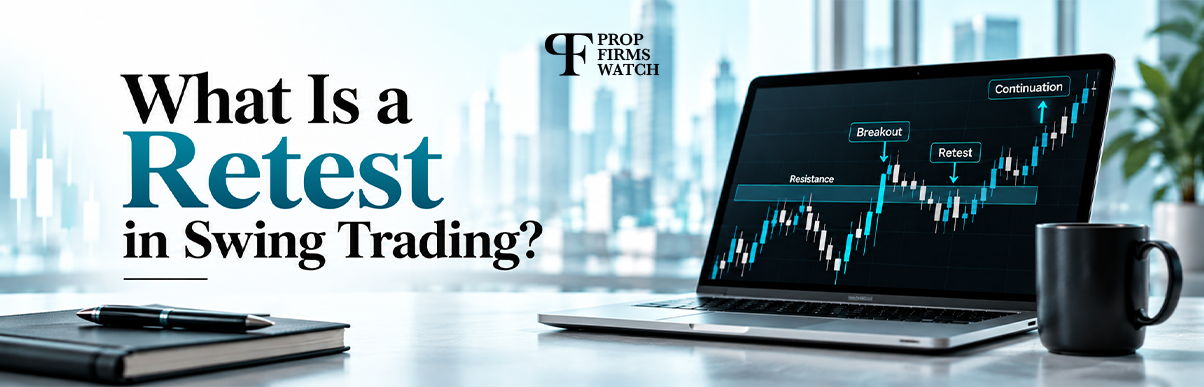
If you are wondering what is a retest in swing trading, think of it as the second interaction with a level after a breakout. In other words, it occurs when price breaks through an important support or resistance level and later returns to test that same level again. For example, when price breaks above resistance and then comes back to test it, that former resistance zone may now act as a support zone. Similarly, a support level can become a resistance level when price returns to it.
Swing traders often wait for a retest instead of jumping into a trade immediately after a breakout occurs. The importance of this is to see whether the broken level will hold price. If the level holds, price will continue in the breakout direction, providing confirmation that the move has strength. However, a retest is not always guaranteed to succeed, which is why traders should consider market momentum, structure, and risk management.
Professional swing traders do value retests because they provide more controlled entry opportunities. Waiting allows traders to avoid chasing price and instead open trades closer to a logical point. This makes retests a useful tool for identifying higher-quality swing trading setups.
A retest in trading is when price breaks through a key resistance or support level, then returns to test that level again. Traders wait for this retest or second interaction and watch out for signs that price is likely to continue in the direction of the breakout.
For example, EUR/USD has repeatedly struggled to break above 1.1600, making it a resistance level. The pair finally breaks above 1.1600 and goes to 1.1680. This move is the breakout, but instead of entering immediately after a breakout, a swing trader waits to see if the price will retrace or retest.
After a while, EUR/USD pulls back from 1.680 toward 1.1600. This return is what is referred to as the retest. If the pair touches the 1.600 level, holds, and moves higher again, the level has now changed from resistance into support. The upward move that follows is the continuation.
Similarly, if EUR/USD falls below the support level, e.g., 1.1500, and later rises to test 1.1500, the support level becomes the resistance level. As a swing trader, it is important to be able to differentiate these terms to ensure you do not get confused when learning. Some common terms include;
Breakout: This is when price moves beyond the resistance or support level.
Retest: Price returns to the broken level.
Rejection: Price fails to break back through the level and reverses.
Continuation: Price resumes moving in the original breakout direction.
A retest trading strategy follows a very simple sequence. The goal is to avoid jumping into the market immediately after a breakout. Instead, wait for a confirmation that the level will hold, then open a trade. Here is exactly how you should do it:
When you open your charts, start by marking an area where price has previously reacted to multiple times. This is your support or resistance level.
Wait for a clear breakout above the resistance level or below the support level. Do not assume that every move beyond a level is a breakout. It could be a rejection, which is why you should wait for that specific breakout candle to fully close.
This is where most traders fail. After a breakout, some swing traders open a trade immediately and then get stopped out. Traders should patiently wait for price to retest the previous level.
Once price has retested, wait for signs such as a strong close away from the level, a rejection candle, or renewed momentum in the direction of the breakout.
If your confirmation is valid, you can enter the trade, but do not chase price.
If in an uptrend, place your stop-loss at old swing lows; that is where the trade setup becomes invalid. For your profit target, look at past highs or aim for a specific risk-to-reward target.
Read 7 Best Forex Swing Trading Strategies
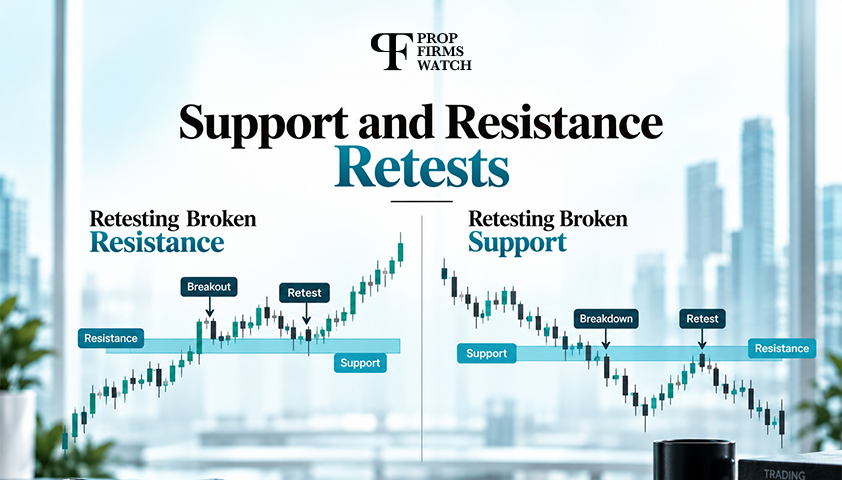
A support and resistance retest occurs when the market breaks through an important level, then later returns to test that same zone. The thing is that a broken level can change its role after the breakout, depending on the direction of the move.
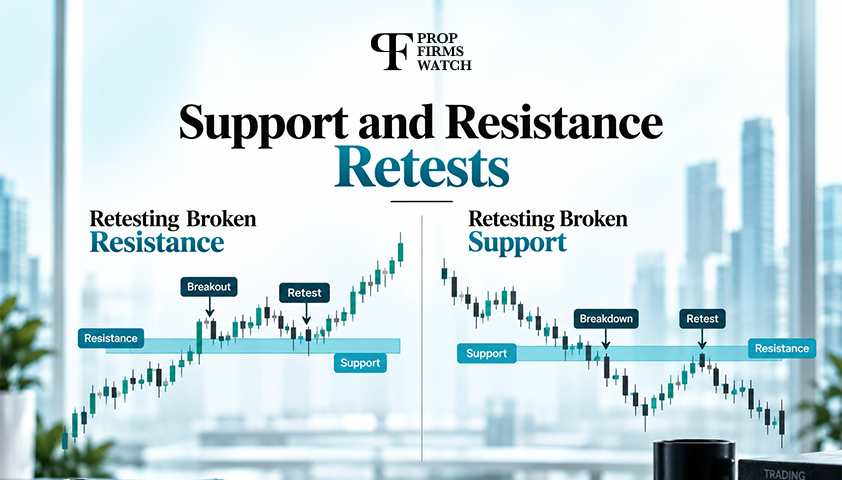
When price breaks above resistance, it establishes a new trading range or direction. If price is followed by a pullback to the former resistance level, this move is what is called a retest. If buyers step in and this old resistance holds, it flips into new support. A successful retest confirms the breakout is valid and signals that price is likely to continue moving higher.
When price breaks below support, it shifts into a bearish move. Price may be followed by a retracement back to the broken level, a move referred to as the retest. If sellers defend this zone and price fails to break back above it, the old support flips into new resistance. This successful retest confirms the breakdown is valid and signals that the downward move is likely to continue.
In both scenarios, swing traders watch how price behaves at the broken level. The reaction that follows is what helps traders determine whether the original breakout will hold or fail.
A valid swing trading retest happens when price returns to the broken level and shows signs that the level is holding price. Swing traders often look for certain confirmations rather than assuming that every retest will lead to a continuation.
Some common signals that can strengthen a retest setup include:
Price respects the previous level: Price tests the broken level without moving past or invalidating the zone.
Rejection candles: Candles with clear rejection or long wicks may show at the level, indicating that buyers or sellers are defending that level.
Strong bullish or bearish candles: A strong displacement candle may move away from the retested level, providing additional confirmation.
Increased momentum: Strong price movement after a pullback suggests that the breakout may still have strength.
Alignment with the broader trend: Retests carry more weight when they align with the prevailing market trend.
Breakout holds: Price should remain beyond the broken level rather than immediately falling back into the previous range.
Swing traders need to note that not every return to a broken level is a valid retest. Price can retest and invalidate the level, which is why traders must patiently wait for clear price action before treating a retest as a potential entry signal. This eliminates false-breakout trades, allowing you to preserve your trading capital.
Learning how to trade a retest begins with waiting for price to confirm that the broken level has shifted roles. The steps mentioned below can be applied to both bullish and bearish swing trading setups.
Identify resistance: Mark out the resistance level on your chart.
Wait for a bullish breakout: Wait for the price to break above the resistance level.
Wait for a pullback: After a breakout, allow price to return to the former resistance level.
Watch for support: Observe how price behaves on the former resistance level. If it holds price, then it becomes a support level.
Look for bullish confirmation: Wait for strong bullish closes, rejection candles, or renewed upward momentum.
Enter the trade: Enter only if the setup remains consistent with your trading plan.
Place the stop-loss: Position the stop below the level where the bullish setup would be invalidated.
Set a target: Use the next resistance area or a predefined risk-to-reward ratio.
The bearish approach follows the opposite logic:
Identify support
Wait for price to break below the support zone
Wait for price to pull back toward the previous support
If price holds, it becomes a resistance level
Wait for a confirmation
Enter the trade and remember to place your stop-loss and set a target.
NOTE: No reset setup is guaranteed to succeed, so risk management is essential when trading.
A stop-loss on a retest should be placed above or below the price level, depending on the direction of the market. That is, beyond the price level that would invalidate the trading setup. The idea is to give the trade more room to develop while spotting the area or zone where the original market thesis is no longer valid.
For a support retest in a bullish setup, the stop-loss should sit below the retest zone. If price goes past the level and continues lower, the expected support may have failed. Traders can also consider placing the stop below a recent swing low, as that may also provide a more logical invalidation point.
For a resistance retest in a bearish setup, place your stop-loss just above the retest zone or a key swing high. A sustained break above this area signals that the setup has failed.
Market volatility also influences stop placement. Highly volatile markets may require more room, while quieter markets may allow tighter stops. Do not set overly tight stop-losses just to lower your risk. Normal market volatility can easily trigger your stop before the price moves in your intended direction. Instead, place your stop exactly where the trading setup is genuinely invalidated, ensuring your position size is adjusted to keep total risk within your plan.
A retest and a pullback involve price momentarily moving against the current market direction. Traders should understand that the two describe different market situations, and knowing the distinctions can help you interpret price action more accurately.
Retest | Pullback |
Usually refers to price returning to a recently broken support or resistance level. | Refers to a broader temporary move against the prevailing trend. |
Focuses on a specific support or resistance level. | May occur without a key support or resistance level being broken. |
Often follows a breakout. | Can happen at any point during an established trend. |
Traders watch whether the broken level holds or fails. | Traders generally watch whether the broader trend remains intact. |
In swing trading retest setups, the broken level is central to the trade idea. Traders observe whether the support or resistance levels will change roles. On the other hand, a pullback is a wider concept. Price can temporarily move lower during an uptrend or higher during a downtrend without having previously broken a major level.
Knowing the difference is important because a retest provides a specific price level to monitor, while a pullback describes the broader counter-trend movement.
A breakout retest can lead to either continuation or reversal. This is why traders should never assume that every return to a broken level confirms the original breakout. Two scenarios can happen when a breakout and retest occur:
A valid retest occurs when price breaks a key level, moves away, and then returns to test that same boundary without breaking back through. Following a bullish breakout, old resistance flips into a support level. Conversely, after a bearish breakdown, old support turns into a ceiling of resistance. When price rejects this level and turns back into the breakout trend, it confirms a clean trend continuation setup.
Fakeouts are failed breakouts. The price spikes past a major support or resistance line, looks promising, but immediately reverses and climbs back inside its previous zone. When a level fails to hold on the back-test, it shows the market wasn't ready to break out, often triggering a sharp move in the opposite direction.
Notice the key difference: After price returns to the broken level, a successful retest confirms the trend is real because the price bounces off the broken level and keeps moving forward. A failed retest means the price slips back across the line, proving the breakout was a fake out.
Breakout and retest setups can provide swing traders with structured trading opportunities. However, if traders do not pay attention to common retest trading mistakes, it can reduce their trading effectiveness. Avoiding these errors can boost trading outcomes significantly.
Entering before the retest: Opening trades immediately after a breakout can have you stopped out before price moves to its intended direction.
Assuming every breakout will retest: Not every breakout leads to a retest. Sometimes prices will break out and continue moving without coming back to the broken level.
Treating every retest as confirmation: A return to the level alone does not confirm continuation. Traders should wait for confirmations.
Ignoring the broader market trend: Traders should always stick to the trend. A retest that goes against the market trend may carry great uncertainty.
Placing stops too close: Tight stops can be triggered by normal market fluctuations before the setup has genuinely failed.
Entering without defining invalidation: Traders should know points where the setup is invalidated if price moves past that area.
Ignoring major news: Economic announcements can cause sudden volatility, spreads, and price movements that disrupt technical setups. Traders should consider the news calendar before entering.
Risking too much on one setup: Even a well-structured retest can fail. Keeping position size and risk within a predetermined limit helps protect trading capital.
The goal is not to achieve a flawless win rate, but to actively manage risk and preserve capital when a retest violates the expected parameters.
Retests do occur on all timeframes, but swing traders usually focus on the higher timeframes as they provide clearer market trends and reduce the noise found on lower timeframes.
4-hour charts: The 4-hour timeframe is popular for identifying swing setups and spotting breakouts, retests, and potential entry areas without excessive short-term price fluctuations.
Daily charts: Daily charts provide a broader view of market structure and can make important support and resistance levels easier to identify. A retest confirmed on this timeframe may carry greater structural significance.
Weekly charts: Weekly charts are useful for higher-timeframe context. They can help traders identify major support, resistance, and the overall direction of the market before looking for setups on lower timeframes.
Higher timeframes help traders identify key support and resistance areas, while the lower timeframes, such as the 1hr, 30 min, and 15 min, are ideal for refining entries after a retest has occurred on the higher timeframes. A practical approach for most swing traders is to utilize the higher timeframes for context and structure, then move to lower timeframes when greater entry precision is needed.
Assume EUR/USD is in a bullish trend. The pair has been trading below 1.1000, which has acted as a resistance level. EUR/USD eventually breaks above 1.1000 and moves to 1.1050, confirming a breakout.
Instead of chasing the move, a swing trader waits for the price to pull back toward 1.1000. The pair returns to the level and holds above it, suggesting that the former resistance may now be acting as support. A bullish candle then forms, providing additional confirmation.
The trader considers a long entry after the bullish signal. The stop-loss is placed below the area where the setup would be invalidated, while the target is based on the next significant resistance level.
Consider this an illustrative example and not a prediction or trading recommendation. Actual price behavior can differ, and a retest can fail even when the setup initially appears valid.
Retests are useful concepts in swing trading. This is because they provide swing traders with a structured way to approach the market when breakouts occur. By understanding how breakouts and retest strategy work, traders no longer chase price, but wait patiently for the market to return to a broken support or resistance level.
When price retests, traders observe whether the zone is holding, then look for a confirmation before entering. While doing so, swing traders must also understand that a retest is not automatically a valid trading opportunity. Price can break through the level again, creating a failed retest or fakeout. This makes proper risk management, clear invalidation points, and patience essential.
Professional swing traders focus on the market structure, which prevents them from reacting to all price movements. They first identify important levels, wait for a confirmed breakout, allow the retest to develop, and look for evidence of continuation before considering an entry. With discipline, patience, and practice, traders know when to wait and when to place a trade.
A retest occurs when price returns to a recently broken support or resistance level to test whether it will hold or not.
Look for a confirmed breakout followed by price returning to the broken level and showing a reaction.
No. A retest specifically involves a broken support or resistance level, while a pullback is a broader temporary move against the trend.
There is no fixed duration. It can last from a few candles to several trading sessions, depending on the timeframe and market conditions.
Not by itself. Traders typically look for rejection, strong price action, or other confirmation that the broken level is holding.
An entry is generally considered after the price confirms that the broken level is holding and shows signs of continuing in the breakout direction.
Yes. Price can move back through the broken level, invalidating the breakout and potentially creating a fakeout.
For swing trading, the 4-hour, daily, and weekly timeframes are commonly useful for identifying structure and important levels.
Disclaimer: This article is for informational purposes only and should not be considered financial advice. Always review each prop firm’s official rules before making a purchase.