October 15, 2026
MT4 vs MT5 for Prop Trading: Which Platform Is Better?
Compare MT4 vs MT5 for prop trading, including features, indicators, Expert Advisors, and trading tools to choose the right platform for your strategy.
View Blog
Review key prop firm rules before starting a challenge. Compare drawdowns, profit targets, and requirements across firms in one place.
July 15, 2026
Swing trading is a common trading style used by traders aiming to capture short to medium-term price swings in the financial market. Unlike day trading, which involves opening and closing trades within the same day, swing trading is about holding positions for several days to weeks.
This trading approach appeals to many traders as it is very flexible and offers bigger returns on a few trading setups. The good thing is that it can be applied to numerous markets, including forex, stocks, indices, commodities, and cryptocurrencies. The strategy adapts seamlessly to diverse currency pairs, market conditions, and trading objectives.
Just like other traders, swing traders must also identify market trends, plan entries and exits, and manage risk effectively. The use of indicators, chart patterns, and technical analysis tools allows these traders to find high probability opportunities without constantly monitoring price movements.
In this guide, we will take you through what swing trading is, how it works, the best indicators and strategies swing traders use, advantages and disadvantages, and whether swing trading is ideal for beginners.
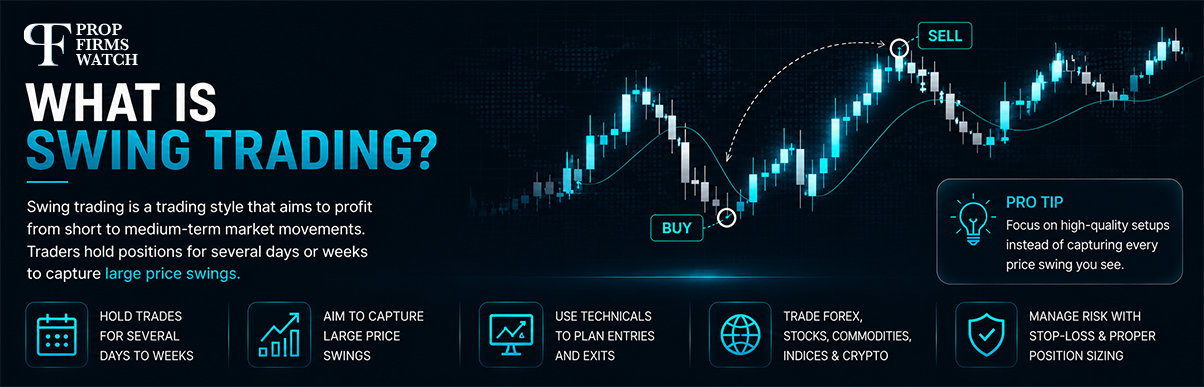
Quick Answer: What Is Swing Trading?Swing trading is a trading style that aims to profit from short to medium-term market movements. Traders hold positions for several days or a few weeks instead of closing and opening positions within the day. Swing traders typically:
Pro Tip: Focus on high-quality setups instead of capturing every price swing you see. Quality setups are always in line with the overall market trend and often produce consistent results. |
Swing trading is a trading strategy whereby traders aim to capture short to medium-term price movements in the market. Instead of capturing moves that end in a few hours or within the day, they wait for those setups that can last for a few days to several weeks.
Swing traders rely on technical analysis and chart patterns to refine their entries. The strategy can be applied in all markets, and the best part is that it offers a balance between the fast pace of day trading and the patience required for long-term investing. Because of this, it has become a popular choice for busy traders and those wanting flexibility without the need to monitor charts constantly.
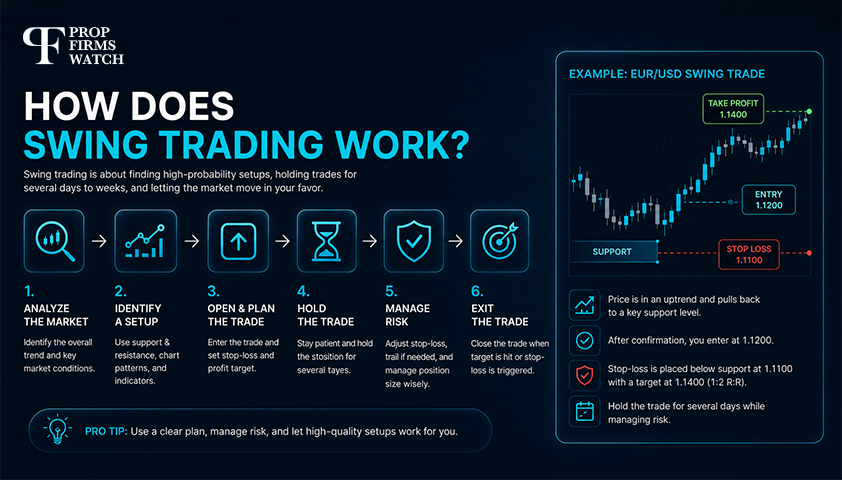
Swing trading entails identifying potential price swings, opening trades at favorable price levels, and holding those positions until a stop-loss or profit target is hit. The process follows these steps:
Analyzing the Market: The trader begins by identifying the overall market trend. Is it trending or range-bound? Once the trader is satisfied, he begins looking for clear trading opportunities.
Identifying a Setup: Traders now use support and resistance levels, chart patterns, and technical indicators to identify potential entries.
Opening and Planning the Trade: As soon as swing traders spot a good entry level, they click buy or sell. They then decide where to place the stop-loss and profit target before the price begins moving.
Holding the Trade: Traders have to be patient and keep positions open for several days while monitoring price movement.
Managing Risk: When the price moves in the intended direction, swing traders begin adjusting their stop loss. They might also add more positions while ensuring they are managing risk appropriately.
Exiting the Trade: Finally, traders exit the market when the price hits their intended target. If it hits a stop loss, swing traders wait for another opportunity.
Suppose you are analyzing EUR/USD and you notice the pair is trending upward. This means that you will be waiting for buying opportunities. The price begins to pull back and hits a key support area. You now wait for a buy confirmation, and once you see it, you click buy.
If the price is currently at 1:2000, you place your stop loss slightly below, say at 1.1100 and you aim for a 1:2 risk-to-reward ratio, which will be at 1:1200. You can also add more positions if the market presents opportunities while ensuring you protect your overall account balance.
In swing trading, you do not have to watch the market all day. Simply analyze the market, know the direction, mark your key levels, set alerts, and once the price is there, wait for a confirmation, then manage the position using stop loss orders.
Swing trading can be implemented across diverse financial markets. As long as there is enough liquidity and volatility, traders can hold and maximize their returns. Specific markets are well-suited for swing trading because they offer tighter spreads and frequent opportunities. They include:
Forex: Major currency pairs like GBP/USD, EUR/USD, and USD/JPY.
Cryptocurrencies: Instruments like Bitcoin and Ethereum have healthy volatility and offer frequent swing trading opportunities.
Commodities: Gold, Silver, and Crude Oil.
Stocks: Shares of actively traded companies like Tesla, NVIDIA, Microsoft, etc.
Indices: Markets like NASDAQ100, S$P 500, and FTSE 100 are also ideal for swing trading.
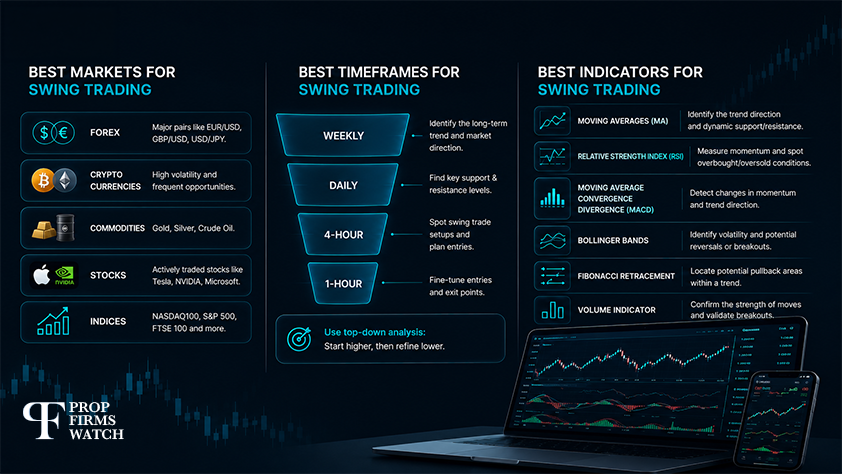
Unlike day trading, which uses lower timeframes to identify entries, swing trading relies on higher timeframes to identify trends and entries. Swing traders normally combine multiple timeframes to improve timing and accuracy. Some commonly used timeframes are:
Weekly Chart: The weekly timeframe allows swing traders to understand and identify the long -term trend of a particular asset.
Daily Chart: This timeframe is for identifying key support and resistance levels.
4-Hour Chart: Suitable for spotting swing trade setups. Here is also where traders can plan entries.
1-Hour Chart: The 1-hour timeframe is for fine-tuning entries and exit points after confirming the overall market trend.
Many swing traders start from the weekly or the daily chart. Once they have identified the overall trend, they will drop down to the lower timeframes to find suitable entry points. This approach is commonly known as top-down analysis. It ensures traders align with the broader market direction, ensuring they catch the best setups.
Swing traders normally utilize multiple indicators to confirm momentum, trends, reversals, and entry points. Since these traders aren’t monitoring the market frequently, indicators allow them to improve the quality of their trading decisions. Some common indicators for swing trading are:
Moving Averages (MA): This is ideal for marking the overall trend of the market.
Relative Strength Index (RSI): Suitable for momentum and also highlights overbought and oversold conditions.
Moving Average Convergence Divergence (MACD): Allows swing traders to spot changes in direction and momentum.
Bollinger Bands: Assists in the identification of possible reversal and breakout opportunities. It also measures market volatility.
Fibonacci Retracement: Helps locate potential pullback areas where the trend may resume after a retracement.
Volume Indicator: Confirms the strength of price movements and validates breakouts.
No indicator will give you 100% accurate results. Therefore, swing traders are usually advised to combine these indicators with price action for much better trading decisions.
Swing traders must use a proven swing trading strategy to remain consistent in the market. There are several swing trading approaches that traders can pick from to spot high probability setups and capture large price swings. Here are some popular swing trading strategies:
Trend Following: Traders trade in the direction of the market. They wait for the price to pull back, then buy in an uptrend or sell in a downtrend.
Breakout Trading: Open trades after price breaks above a major resistance or below a support area.
Support and Resistance Trading: This strategy involves waiting for the price to reach support levels, then buying and selling when it’s near resistance levels.
Moving Average Crossover: Swing traders use two moving averages to identify buying and selling areas.
RSI Divergence: Traders look for differences between price movement and use the RSI to spot possible trend reversals.
Range Trading: Buy near the bottom of a trading range and sell near the top when the market lacks a clear trend.
Price Action: Swing traders use the formation of candlesticks and market patterns to identify trading opportunities in the market. No need for an indicator when using the price action strategy.
No single swing trading strategy is better than the other one. The secret is to find one that works for you, back test it several times, and apply it consistently alongside risk management. With time, you’ll realize that the strategy works better than it used to. Not because it is the best, but because you’ve understood how to apply it in your trades.
Both swing trading and day trading can make you significant profits from the market. However, they differ in time commitment, duration, and trading style. Here is how they compare:
Features | Swing Trading | Day Trading |
Holding Period | Several days to weeks | A few hours to one trading day |
Time Commitment | Moderate | High |
Overnight Positions | Yes | No |
No. of Trades | Fewer | 1 to 2 within the day |
Main Timeframes | Weekly, daily, 4-hour | 1-hour, 15min, 5min |
Stress Levels | Low | High |
Best For | Part-time traders | Full-time traders |
Swing trading is for traders who are seeking flexibility, while day trading is for active traders who want to be in the market constantly. The right one depends on your trading goals, schedule, and risk tolerance.
Swing trading and scalping are actively traded strategies in the market, but they also differ in trading frequency, duration, and required screen time.
Features | Swing Trading | Scalping |
Holding Period | Several days to weeks | Seconds to minutes |
No. of Trades | 1 or 2 in a week | 50 to 100 trades in a day |
Time Commitment | Moderate | Very high |
Primary Timeframes | Weekly, daily, and 4-hour | 5min, 1min |
Target | Large price swings | Small price swings |
Stress Level | Moderate | High |
Best For | Patient traders | Fast-paced and experienced traders. |
While swing trading requires patience, scalping demands quick decision-making, as it targets small price fluctuations. In swing trading, you can only take 1 to 2 trades in a week, and in scalping, traders can open up to 100 trades in a day.
Swing trading and position trading require traders to hold positions longer, but they still differ in a few ways. Here is a breakdown of the differences:
Features | Swing Trading | Position Trading |
Holding Period | Several days to weeks | Several weeks to months |
Primary Focus | Short to medium-term price swings | Long-term market trends |
Timeframes | Weekly, daily, 4-hour | Monthly, weekly, daily |
No. of trades | Regular | Few each year |
Market Monitoring | Moderate | Low |
Overnight Holding | Yes | Yes |
Best For | Weekly traders | Long-term trend followers |
Unlike swing trading, position trading focuses on capturing larger price swings that occur in weeks or even months. Swing traders generally take more trades than position traders, but in position trading, returns are much bigger than in swing trading, as profit targets are also wider.
Swing trading comes with several advantages, making it one of the most used trading styles in the trading industry. Some key benefits include:
Less Screen Time: Unlike day traders, swing traders don’t need to monitor the markets all day to get opportunities.
Large Profit Potentials: Since targets are large, profits are also bigger.
Flexible Schedule: Swing trading supports a healthy work-life balance by reducing screen time.
Lower Trading Cost: Fewer trades mean lower transaction fees and commissions.
Reduced Stress: Decisions are not made within minutes or seconds. Traders take time to think about their decisions.
Works in Various Markets: Swing traders can trade different assets, including forex, stocks, commodities, etc.
Key Takeaway: The advantages of swing trading are not what will make you a profitable trader. You still require discipline, patience, and proper risk management to see results. These benefits are an added bonus to an already powerful trading style.
Despite the benefits, this strategy is not without risks. Here are the unique challenges you are most likely to face when using this trading style:
Overnight Risk: Since swing traders are required to hold positions overnight, it could present potential risk. Price gaps due to major economic news could affect results.
Slower Results: Trades take a long time to mature and hit the target.
Capital Tied Up: Your funds are committed to open positions until the trades are closed.
Emotional Challenges: A high level of discipline and patience is required.
Missed Opportunities: Capital locked in a trade may prevent you from taking other opportunities.
Swap or financing fees: Holding positions overnight may result in additional costs.
Knowing the challenges ahead allows traders to set realistic expectations when swing trading. With the information, traders can plan and implement sound risk management suitable for swing trading strategies.
Yes, swing trading is a suitable trading style for beginners. This is because the strategy offers more time for market analysis and requires less screen time. Traders who are not yet used to the market can take time to figure out whether the opportunity presented is ideal or not. Instead of acting instantly on a trade setup, they think through it before making a move. This eases the pressure and improves the chances of succeeding in a trade.
However, beginner traders must understand that swing trading is not all about opening and holding trades. It is also about understanding the technical, developing a working strategy, and practicing it continuously. Success in swing trading involves understanding how the markets move and when to stay away from the markets.
Risk management is the most important aspect of successful trading. Even with the best strategy, traders cannot achieve consistent results if they do not apply proper risk management. A few risk management practices that swing traders need to follow include:
Risk only 1 to 2% of trading capital on any particular trade
Aim for a 1:2 risk-to-reward ratio, or more, depending on the setup
Use the correct position size to protect trading capital
Always use a stop loss to limit losses
Do not risk all your capital in one position. Instead, diversify.
Stick to your trading plan no matter the circumstances.
Proper risk management won’t prevent losses, but it will ensure you protect your trading capital so that you can continue trading. Capital preservation is the first rule in trading, and that means applying disciplined risk management to every single trade.
Many swing traders keep sabotaging their progress, not because they don’t know how to trade, but because they keep making the same avoidable mistakes. Recognizing these pitfalls can significantly improve your performance. Common mistakes include:
Risking too much on one single trade
Taking trades without a plan and opening positions based on emotions
Ignoring stop-loss orders, leading to blowing accounts
Overtrading after a loss in the hopes of recovering the money
Chasing the market after a strong move (FOMO)
Trading against the trend
Failing to keep a trading journal, which helps you improve your trading.
Successful swing trading also involves understanding the mistakes that are dragging you behind. This is why it’s important to keep a trading journal so that you can review and correct those mistakes. Over time, you’ll notice your risk management has improved, and you are getting more consistent results.
Yes, you can swing trade with prop firms if the firm’s rules allow it. Many prop firms support swing trading, but there are some that do not favor swing trading because of their rules and restrictions. Rules in prop firms do vary, and that is why it's important to review a firm’s trading conditions before purchasing an evaluation.
Finding a prop firm that aligns with your trading approach may be overwhelming. Luckily, there is PFWatch, which is a tool that helps traders compare rules across multiple firms. If you accidentally purchase a firm that doesn’t allow overnight positions, it means that you cannot swing trade effectively. PFWatch allows you to avoid such kinds of mistakes while ensuring you get a firm that will improve your chances of long-term success.
Not all prop firms are the same. Different firms come with different trading rules. This is why it's important to compare every firm’s rules to purchase what aligns with your trading goals.
Here is why you should consider when choosing a prop firm for swing trading:
Overnight holding: Check whether the firm allows traders to hold positions overnight.
Weekend holding: Confirm whether positions can remain open during the weekend.
News trading: Does the firm allow traders to keep positions open during major economic events?
Drawdown rules: Are the drawdown rules reasonable?
Profit split: How much does the firm keep, and how much of your profits can you keep?
Markets available: Ensure the firm offers the assets you want to trade.
Trading Platforms: What trading platforms does the firm offer, and can you find your preferred platform?
Evaluation requirements: Understand the trading rules and profit targets set before starting an evaluation.
Instead of scrolling through pages, use PFWatch to find a prop firm that you are looking for. This tool saves you time, money, and future regrets. It makes the process easier, allowing you to trade with a firm that supports your trading style.
Swing trading is a popular trading style among traders who are seeking flexibility. The strategy allows traders to profit from short to medium-term price swings and requires less screen time. Swing trading also offers larger profit potential and is less stressful as compared to day trading. This is because it does not require fast decision-making, and that makes it ideal for beginners.
Throughout the article, we have also seen how swing trading compares to scalping and position trading. But just like any other trading style, swing trading also requires discipline, patience, and proper risk management. If you plan to start swing trading with prop firms, choosing a firm that aligns with your strategy could make all the difference between failing and succeeding.
A firm that restricts overnight holdings, news trading, and weekend trading could be your biggest downfall when swing trading. With PFWatch, you can select a good prop firm that matches your trading aspirations and goals. The tool allows you to compare firms side by side, ensuring you get the best firms for swing trading.
Swing traders normally hold positions for a few days to several weeks, depending on their trading strategy and market conditions.
Yes, swing trading offers a lot of flexibility as it does not require constant market monitoring. This makes it suitable for traders with full-time jobs.
There is no best indicator for swing trading. Many successful swing traders combine indicators to improve and refine their entries.
Swing traders can trade all markets, including forex, stocks, commodities, cryptocurrencies, and indices. None is better than the other; it just depends on your preference.
Swing trading can be profitable when paired with proper risk management, discipline, and patience.
Disclaimer: This article is for informational purposes only and should not be considered financial advice. Always review each prop firm’s official rules before making a purchase.