What is scalping in trading? Scalping is a short-term trading style where traders open and close trades within minutes. The aim is to capture small price movements that occur within a short period of time. Unlike day trading or swing trading, scalping mainly focuses on small price targets, frequent trades, and very short holding periods.
Scalpers execute numerous trades during the day, aiming to accumulate profits while limiting risk exposure to their trading account. The scalping strategy requires execution speed and sound risk management because positions are held for a very short time. Wider spreads, small delays, and poorly placed market orders can significantly impact your trading outcome.
The fast-paced nature of scalping requires a clear strategy, discipline, and the ability to make decisions quickly. In this guide, we will look at how scalping works, the best scalping strategies, and what traders should consider before scalping.
What Is Scalping in Trading?
Scalping in trading is a high-speed trading strategy where traders open and close positions within minutes or seconds to capture tiny, frequent price movements. Scalpers usually focus on capturing multiple small gains rather than holding positions for hours or days. They may execute hundreds of trades during a trading session, depending on their risk management plan, strategy, and market conditions.
In scalping, each trade targets a small price change, which is why scalpers prefer brokers with low spreads, low trading costs, and fast execution speed. Liquidity allows scalpers to enter and exit positions more easily, while volatility ensures they find multiple opportunities throughout the day or session.
For example, a trader buys EUR/USD at 1.5850, expecting a short-term bullish move. A few minutes later, the exchange rate rises to 1.5950, so the trader closes the position and locks in a small gain of 10 pips. The trader is not trying to capture a large market move. Instead, the goal is to profit from small price changes repeatedly. Repeating similar trades can potentially build returns over time.
How Does Scalping Work?
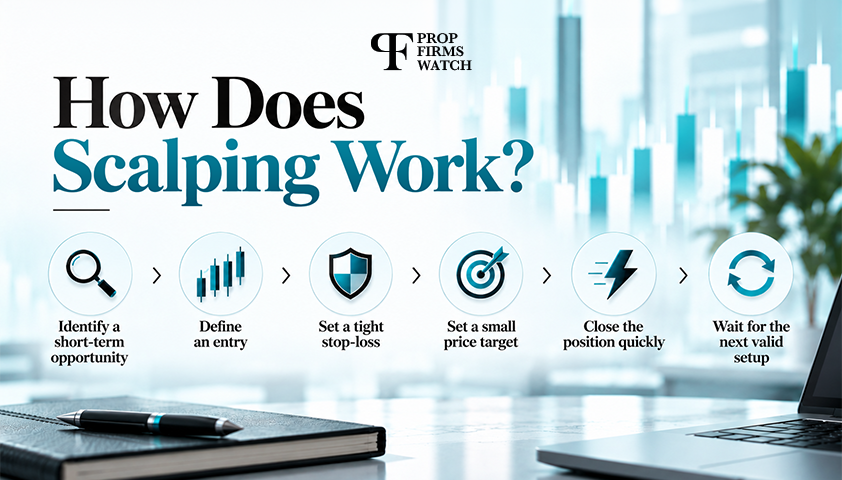
How does scalping work? The process involves spotting short-term trading opportunities, executing them quickly, and managing them to capture small price movements. A typical scalping trading strategy follows these steps:
Identify a short-term opportunity: Find a clear setup based on indicators, price action, and market conditions.
Define an entry: Decide where exactly to open the trade.
Set a tight stop-loss: Protect your account by setting a tight stop-loss if the market moves against the position.
Set a small price target: Aim for a modest price movement rather than large price movements.
Close the position quickly: Exit when the target is reached, or the setup becomes invalid.
Wait for the next valid setup: Repeat the same process only when another suitable opportunity appears.
As much as scalping is about opening multiple trades within a session, it is also about picking quality setups, remaining disciplined, and applying sound risk management to all your trades.
What Markets Can You Scalp?

Scalping can be applied across multiple financial instruments, including indices, forex, stocks, commodities, and cryptocurrencies. The suitability depends on the market conditions, and no one market is universally best for scalping.
Forex: Major pairs often have high liquidity, fast execution, and tight spreads, which support high-frequency trading.
Indices: Index markets can offer periods of strong volatility, creating opportunities for short-term price movements.
Commodities: Markets such as gold and crude oil experience significant intraday movements. Volatility is also high for these markets.
Stocks: Highly liquid stocks with active trading volumes may provide suitable short-term opportunities.
Cryptocurrencies: Crypto markets operate around the clock and can experience substantial volatility, but spreads and liquidity vary considerably between assets.
As an aspiring scalp trader, it is important to note that volatility, liquidity, spreads, and execution speed are the most important factors when it comes to scalping trading. These factors can influence how easily you make profits, enter and exit positions, and how often you get opportunities.
What Timeframes Do Scalpers Use?
A good scalping strategy for beginners and professionals is mostly done on the lower timeframes. Scalpers identify and manage short-term price movements in the 1 min, 5 min, and 15 min timeframes, which are the best timeframes for scalping.
The 15 min chart provides a broader view of where price is going and the current short-term trend of the market. The 5 min chart, on the other hand, provides a balance between detail and market noise, making it an ideal timeframe for short-term setups. In the 1 min timeframe is where many scalpers go for detailed price action and to execute trades with precision.
However, traders do not only need to rely on the lower timeframes for the market trend or price action. Traders can check the higher-timeframe context to understand the broader market direction. For example, a trader might use the 5-minute chart to identify an entry while checking the 1-hour chart to determine the overall trend. This can help align short-term trades with broader market conditions.
Common Scalping Strategies
To scalp successfully, you need a strategy. There are different approaches you can use to identify short-term scalping opportunities. The best strategy will depend on your risk tolerance, pair or asset, trading style, and market conditions. Some common scalping strategies traders use include;
Moving Average Scalping
This strategy uses the moving average indicators to identify momentum and potential entry and exit points depending on the direction of the market.
Support and Resistance Scalping
This strategy centers on how price behaves near resistance and support levels, aiming to exploit quick trend extensions or sudden turnarounds.
Breakout Scalping
Breakout scalping focuses on entering trades the exact moment an asset forces its way through an established price floor or ceiling. Traders use this technique to capture the explosive, high-speed price movement that typically happens immediately after a range is broken.
Pullback Scalping
Pullback scalping involves waiting for a strong trending asset to briefly dip or bounce against its current momentum before entering the trade. This allows traders to buy at discount zones and sell at premium areas.
Momentum Scalping
Momentum scalping involves jumping into an asset that is already moving fast and heavy in one direction, riding the wave of high volume. Traders exit the position at the very first sign that the buying or selling pressure is starting to slow down.
How Do Scalpers Enter and Exit Trades?
Learning how to scalp trade begins with having predefined rules for your trades. Rather than making impulsive decisions, scalpers must have certain conditions for entering and exiting trades. If the conditions are not met, then there should be no need to take a trade. Some important rules traders must include in their plan are:
An Entry Trigger, which defines when to enter.
A stop-loss limits the potential loss if the trade moves against the position.
A take-profit, which sets the intended exit when the target is attained.
Traders should also have a reasonable risk-to-reward ratio and know what position size is appropriate for their account size.
Aside from that, traders must have a maximum number of trades they can take in a day. This prevents overtrading or revenge trading after losses.
Rules are fundamental in trading, especially when the expected price movement is smaller. This is where commissions, spreads, and execution costs become more significant. Taking trades without a plan or predefined rules can get you on the negative side because costs can minimize or eliminate potential profit.
Advantages of Scalping
Scalping comes with several potential advantages, especially for traders who prefer the fast-paced approach and want to manage short-term price movements in the market.
Scalping offers many trading opportunities: Short holding periods provide multiple opportunities when market conditions are volatile.
No overnight positions: In scalping, traders close their positions before the end of a session, which eliminates overnight risk exposure.
Short market exposure: Positions remain active for brief periods, minimizing the time spent exposed to unexpected market changes.
Immediate feedback: Traders do not have to wait for hours to get results. They quickly get to assess whether their strategy is working or not.
Works across liquid markets: Scalping works across multiple assets, including stocks, forex, commodities, crypto, and indices. As long as the market is liquid and trading conditions are great, scalpers can open positions.
These advantages do not come automatically; they take discipline, patience, strict rules, consistent execution, and sound risk management.
Risks of Scalping
Scalping can expose traders to high risk because decisions and executions happen quickly:
Transaction costs: A high number of trades can cause commissions and other fees to pile up or accumulate.
Spread: Wide spreads can minimize potential trade outcomes. Because price movements are small, a tight spread is required to make significant profits.
Slippage: Fast markets may cause orders to fill at prices different from those expected.
Overtrading: Frequent setups can tempt traders to enter positions without a valid signal.
Market noise: Short-term charts can produce false signals and unpredictable movements.
Fast losses: Small price movements can quickly turn against a position.
Emotional decisions: Rapid wins and losses can encourage impulsive trading.
Execution issues: Delays, rejected orders, or platform problems can affect entries and exits.
Fatigue: Constant concentration can lead to mistakes and poor decisions.
Numerous trades do not make a strategy automatically profitable, especially if the losing trades and trading costs are too high.
Scalping vs Day Trading
Scalping vs day trading mainly differ in trade duration, intensity of execution, and frequency. Both approaches do not require overnight holding, but scalpers hold trades for a much shorter period and target small price movements.
Features | Scalping | Day Trading |
Holding Period | Seconds to minutes | Minutes to hours |
Trade Frequency | High | Moderate |
Target | Small price movements | Large Intraday moves |
Overnight Positions | Usually avoided | Usually avoided |
Execution Requirements | Very high | High
|
Market Monitoring | Intensive | Moderately intensive
|
Scalping vs Swing Trading
Scalping vs swing trading differs in how long positions are held in the market, how frequently trades are taken, and how closely the trades need to be monitored. Here is a comparison table that will help you understand the two strategies better:
Features | Scalping
| Swing Trading |
Holding Period | Seconds to Minutes
| Days to weeks |
Trade Frequency | High
| Lower |
Chart Focus | Lower timeframes
| Higher timeframes |
Market Monitoring | Frequent
| Less Frequent |
Typical Target | Small moves
| Large moves |
Is Scalping Suitable for Beginners?
Scalping is ideal for beginners who are willing to learn and practice consistently. Just because the concept sounds easy, it does not mean that you will become profitable immediately when you start trading. The basic concept is very straightforward: open a trade, capture small price movements, and exit quickly. Behind the curtain are other things beginner scalpers should understand to make the process consistently easy; they include:
Risk management: Know how much to risk on each trade.
Position sizing: Adjust trade size according to account capital.
Trading costs: Understand spreads and commissions.
Order execution: Learn how market, limit, and stop orders work.
Market structure: Understand trends, ranges, support, and resistance.
Emotional discipline: Avoid impulsive decisions and revenge trading.
The demo environment exists to help beginner traders test their scalping strategy before risking their hard-earned money.
Common Scalping Mistakes
As mentioned above, scalping requires discipline and risk management because small avoidable mistakes can cost you your account. These common mistakes are:
Overtrading: Taking too many trades without valid setups.
Trading without a stop-loss: Leaving positions exposed to potentially large losses.
Using excessive leverage: Taking on more risk than the account can reasonably handle.
Trading every movement: Treating normal market noise as a trading signal.
Entering after a move: Chasing price after the opportunity has already occurred.
Increasing position size after losses: Attempting to recover losses through larger trades.
Ignoring spreads and commissions: Allowing trading costs to reduce potential returns.
Ignoring major economic news: Failing to account for events that can cause sudden volatility.
No daily loss limit: Continuing to trade after reaching a predetermined loss threshold.
Poor trading records: Failing to track trades, mistakes, and performance for future improvement.
Risk Management for Scalping
In scalp trading, profitable trades can turn into losses very quickly. This is because frequent trades and tiny price targets can make losses and trading costs accumulate quickly, leading to a negative balance by the end of the day. This is where risk management comes in. Scalping does not promise consistent profitability, which is why your number one job is to preserve your capital for better opportunities. Here is how you can do it:
Risk per trade: Define a small, consistent amount of account capital to risk on each position. 1 to 2% per trade is the most recommended.
Position sizing: Adjust trade size according to the distance between the entry and stop-loss.
Daily loss limits: Establish a maximum amount you are willing to lose in one session.
Stop-loss placement: Set a stop-loss before entering and place it at a level that invalidates the trade setup.
Maximum consecutive losses: Stop trading after a predefined number of losing trades to prevent emotional decisions.
Trading costs: Account for spreads, commissions, and potential slippage.
Know when to stop: End the session when your loss limit is reached, concentration declines, or market conditions no longer suit your strategy.
Example of a Scalping Trade
Here is an illustrative example that will help you understand scalping in detail. Note that this is just an example and not a trading recommendation.
Assume EUR/USD is trading around 1.1550. The market pulls back slightly, and the scalper identifies short-term bullish momentum and enters the position at 1.1540. The market then begins to go long; the trader sets his stop loss at 1.1535 and his target at 1.1550. Eventually, the price moves in his direction and hits take profit.
In this case;
The Entry: 1.1540 is the entry after a pullback appears.
Stop-loss: This is the predefined level below the entry, which is 1.1535. It helps limit potential losses if the setup fails.
Target: 1.1550 is the target, where the scalper exits after price moves in their direction.
Why does it qualify as a scalping setup? This is because the position taken targets a small price shift and is intended to remain open for a few minutes.
Some of the things that could invalidate the setup are weakening momentum, price breaking below the short-term support, or price moving against the anticipated direction.
Conclusion
Scalping is a short-term trading strategy that mainly focuses on small price movements within a short period. In this style of trading, the holding period is very short, and traders take numerous trades within an active session or day. Scalpers can trade any asset in the market, such as commodities, forex, indices, crypto, and stocks, provided liquidity, volatility, and market conditions are favorable.
The scalping strategy provides traders with many opportunities, minimizes prolonged market exposure, and traders do not have to expose their accounts to overnight risk. However, it comes with significant risks, especially when commissions, spreads, slippage, and execution issues are not carefully considered. The approach may also lead to overtrading and emotional decisions, which affect profits in the long run.
Professional scalpers use effective risk management, have predefined rules, and take discipline seriously to be consistently profitable in the market. Scalping is not about opening random trades just because the market is moving. Clear rules need to be set for when to enter and exit trades. Successful execution paired with discipline, preparation, and proper risk management will take you far.
FAQs
What is scalping in trading?
Scalping is a short-term trading style where traders open and close positions within seconds or minutes to capture small price movements.
Is scalping profitable?
Scalping can be profitable, but it is not guaranteed. Results depend on strategy, execution, and risk management.
How long do scalping trades last?
Most scalping trades last from a few seconds to several minutes, although some may remain open longer depending on the setup.
What timeframe is best for scalping?
The 1-minute, 5-minute, and 15-minute charts are commonly used. Traders may also use higher timeframes for broader market context.
Is scalping good for beginners?
It can be, but beginners should practice on a demo account before risking significant capital.
What markets are best for scalping?
Forex, indices, stocks, commodities, and cryptocurrencies can all be scalped. Markets with good liquidity, suitable volatility, tight spreads, and efficient execution are generally more suitable.
How many trades do scalpers make a day?
There is no fixed number. Some scalpers may make several trades, while others may execute dozens or more depending on their strategy and market conditions.
What is the difference between scalping and day trading?
Scalping involves shorter holding periods and more frequent trades, while day trading typically holds positions for minutes to hours to capture larger intraday price movements.
Is scalping risky?
Yes. Scalping can involve rapid losses, frequent transaction costs, slippage, market noise, and emotional pressure. Strict risk management is essential.
Can you scalp forex?
Yes. Forex is commonly used for scalping because major currency pairs often offer high liquidity, tight spreads, and frequent short-term price movements.