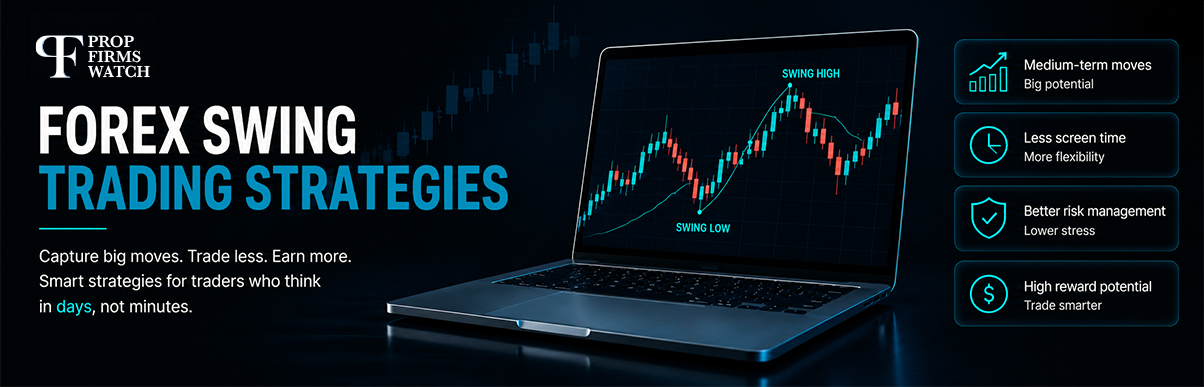
THE SHORT ANSWER Forex swing trading strategies are trading methods designed to capture medium-term price movements by holding positions for several days or weeks. Popular forex swing trading strategies include trend following, breakout trading, moving average pullbacks, Fibonacci retracements, price action trading, and range trading. These strategies help traders identify high-probability setups while reducing the need for constant market monitoring. |
Many traders looking for a more flexible approach to the markets are interested in forex swing trading strategies because they do not demand much of their time. Day trading often demands a lot of screen time and constant market monitoring. On the other hand, swing trading is less stressful as it offers a slower pace, allowing traders to focus on movements that occur over several days. For traders with full-time jobs or other responsibilities, this looks like an attractive option.
Traders can simply participate in trading without being glued to the screen for hours. However, this does not mean that swing trading is a shortcut to success. New traders normally assume that swing trading is easy because the trades last longer. But just like day trading, profitable swing trading also requires proper risk management, patience, and discipline.
Before swing trading, traders must know and understand swing trading strategies, learn to identify high probability trades, and apply effective risk management to protect their trading capital. Without the right foundation, you can quickly lose your account and even lose confidence in trading.
In this guide, we will take you through the ins and outs of swing trading. From what forex swing trading is to how it works. We will also cover some of the best swing trading strategies that will make you profitable.
What Is Forex Swing Trading?
Forex swing trading is a trading method that involves capturing medium-term price movements or swings that can happen over several days. Unlike day trading, where traders open and close trades within hours or a single day, swing trading is about opening positions and holding them longer. Traders can then benefit from large price swings, turning their small investments into huge returns.
How Does Forex Swing Trading Work?
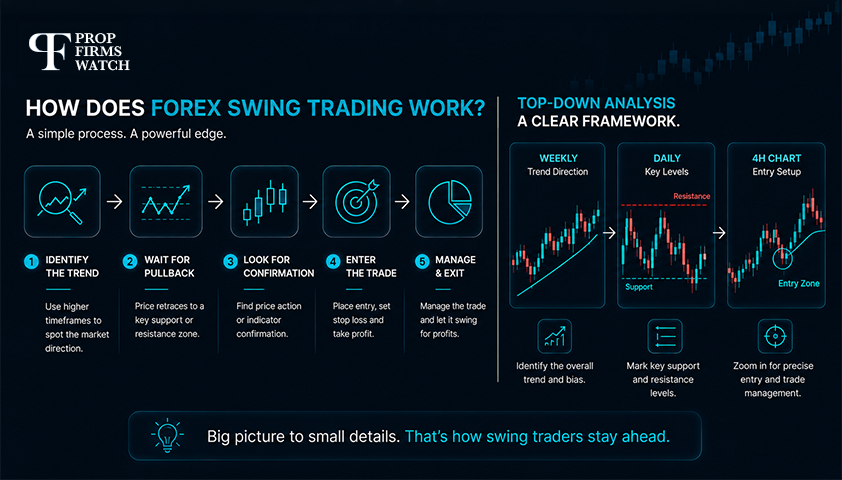
Swing traders first begin by identifying an established trend. They then wait for a consolidation or a retracement. As soon as the price reaches their area of interest, traders take buy or sell trades if the market shows a higher probability of a continuation.
Swing trading ensures traders focus on meaningful trades rather than opening every small price fluctuation on the lower timeframes. The majority of swing traders normally rely on higher timeframes to eliminate market noise and enhance the quality of their trades. This simply tells that you must have a clear top-down approach to execute trades perfectly.
The daily and 4-hour timeframes are usually considered the primary charts for swing trading. The daily allows traders to identify established trends, support and resistance levels, and reversal zones. Meanwhile, the 4-hour chart is for closer inspection of the price to quickly identify trade entries and manage them effectively.
The weekly chart is also a supporting timeframe when it comes to swing trading. It offers a broader look at the market, allowing traders to determine dominant long-term trends. Some swing traders will also go as low as the 1-hour chart to fine-tune their entries once the price is at a key support or resistance level.
This approach of looking at price from a higher timeframe to a lower timeframe is known as top-down analysis. Instead of using a single chart to execute trades, traders analyze price from a higher chart to a lower chart to find quality setups.
Here is how a swing trading top-down analysis looks:
By following this process, traders can avoid taking trades impulsively. This analysis ensures traders are always sticking to the trend and waiting for confirmations before opening trades. The process is straightforward and forms the foundation of most profitable forex swing trading strategies.
Best Time Frames for Forex Swing Trading
Time Frame | Purpose |
|---|
Weekly | Identify the primary trend |
Daily | Market structure and key levels |
4-Hour | Trade setups and entries |
1-Hour | Fine-tune entries |
Advantages and Disadvantages of Swing Trading
Like most trading styles, swing trading also has its strengths and limitations. They are;
Pros
Requires less screen time compared to day trading
Offers more time to plan and analyze the setups before opening positions
High reward potential. Traders target huge price moves
Low emotional pressure because decisions are not made quickly
Lower trading costs due to fewer transactions
Cons
Exposure to overnight or weekend market risk
Requires a high level of patience
Might require a larger stop-loss, which means bigger capital.
7 Best Forex Swing Trading Strategies
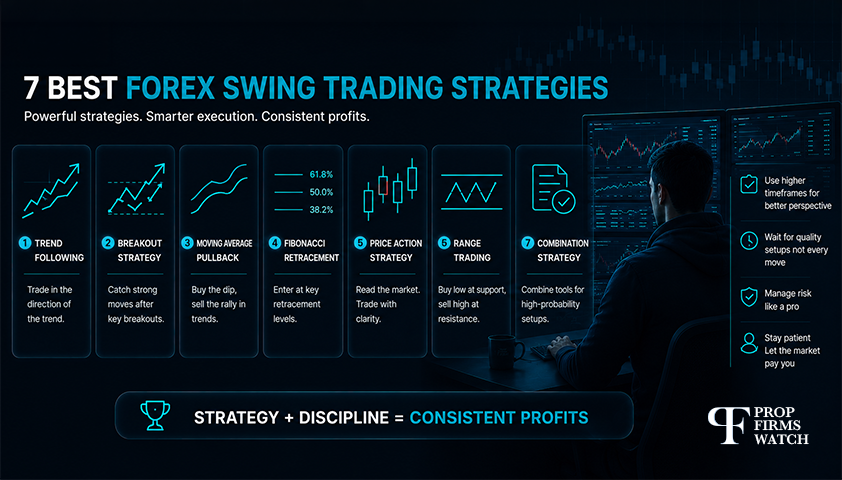
The best forex swing trading strategy is the one that matches your trading style and risk management approach. Here are strategies that have been tested and widely used by professional traders;
1. Trend Following Strategy
The trend following strategy is a popular swing trading strategy that mainly focuses on the direction of the market. Traders who use this strategy only trade with the direction of the prevailing market trend. Rather than trying to catch reversals, traders only look for opportunities that align with the existing direction of the market.
Most times, you will hear professional traders saying “the trend is your friend.” If you have observed the market, you’ll realize that an expansion is often followed by a retracement or correction. During this retracement, some traders tend to sell during an uptrend or buy in a downtrend and end up being stopped out. In the trend following strategy, you do not do this. You first wait for the market to make a temporary pullback before opening a trade. This way, you get a better buying or selling price.
Best Indicators for Trend Following Strategy: 200-period Exponential Moving Average (EMA) and 50-period Exponential Moving Average (EMA).
Ideal Market Conditions: Clear bullish and bearish momentum markets.
Example
Assuming you are trading EUR/USD and the market is on an uptrend. This means the market is making a series of higher highs and higher lows. After creating a higher high, the market begins to pull back to the 50 EMA. Once you spot a confirmation, you place a buy position with the stop-loss below a recent swing low and take profit orders on highs that haven’t been taken out.
Pros
Cons
2. Breakout Swing Trading Strategy
Breakout trading involves capturing the strong momentum that normally follows when a price breaks out of a consolidation or an important trading range. When markets rally for a long time, they often pause before making another major move. During these pauses, the price usually trades between well-defined support and resistance levels, forming a consolidation.
In the consolidation is where most traders get trapped by fake breakouts. But professional traders usually wait for three main things: a convincing breakout, a retest of the broken level, and a confirmation that the market is ready to go up.
Best Indicators: Volume profiles, Average True Range (ART
Ideal Market Conditions: Consolidating markets before major moves and strong momentum markets after major economic events.
Example
USDCAD spends days consolidating after an expansion, creating key resistance and support areas. Price then breaks out of a resistance zone and then later retests the area as new support before expanding. Swing traders then enter and ride the new wave.
Pros
It provides clear entry and exit levels
The strategy captures large price movements
Ideal for both bullish and bearish markets
Cons
3. Moving Average Pullback Strategy
This is another swing trading strategy that can be profitable if understood well. The strategy combines trend trading and moving averages to spot temporary pullbacks in an already established trend. Most traders usually use the 20 EMA and 50 EMA to identify support and resistance areas.
In an uptrend, the price will pull back to one of the moving averages before trending higher. Once the price has traded towards the EMA, swing traders will look for a confirmation and then enter.
Best Indicators: Moving average indicator, i.e., 20 EMA, 50 EMA
Ideal Market Conditions: Moderate volatile markets and healthy trending environments.
Example
Assuming GBP/JPY is trading above the 20 EMA and 50 EMA. The market then retraces to the 20 EMA. From this point, a swing trader only needs to wait for a confirmation to enter long. He places the stop loss below the recent low, and the targets go to the resistance levels.
Pros
Prevents emotional decisions
Performs well with price action
Provides conditions for structured trade entries
Cons
4. Fibonacci Retracement Strategy
A Fibonacci Retracement is a technical analysis tool that allows traders to identify premium and discount zones. With the tool, you can easily spot pullback levels where the price is likely to reach before it resumes. Swing traders first identify a key swing high and low after a strong price movement. They will then draw the Fibonacci tool from swing low to high and then monitor key areas like the discount or premium level, particularly, 38.2%, 50%, and 61.8%.
During an uptrend, swing traders wait for the price to tap into the discount area to buy and vice versa. However, traders are advised to combine other strategies with Fibonacci retracement for better results.
Best Indicators: Fibonacci Retracement, pivot points
Ideal Market Conditions: Healthy market pullbacks, during established trends
Example
Suppose EUR/USD is in a bearish trend and swing traders are waiting to place a sell trade. So, they wait for the market to retrace to the 50% Fibonacci level to open a trade. After the market has reached your preferred Fib level, a confirmation is all you need to sell.
Pros
It is easy even for beginners
It offers precise entries
Widely used by experienced swing traders
Cons
5. Price Action Swing Trading
Price action swing trading is all about understanding the behavior of the market rather than relying on indicators. This is the strategy many professional swing traders use because it reflects the raw, real-time footprints of market supply and demand.
This strategy also eliminates the need for traditional indicators that lag, causing traders to open and close trades early/late. Traders simply look at candlestick formations and market movements to identify potential trading setups.
Best Indicators: Most price action traders use one or two or no indicators. Trendline tools and Fibonacci Retracements may be some that might be considered.
Ideal Market Conditions: Trending markets and where key levels may be spotted easily.
Example
AUD/USD is creating higher highs and higher lows. A swing trader notices that before the market makes another higher high, it consolidates or retraces. The trader then marks his supply levels and waits for the price to tap in. Once the market reaches that level, the trader will then wait for an engulfing candle or any other confirmation indicating that the price is ready to go up. The trader then buys, sets a stop loss, and a take-profit order without the need for an indicator.
Pros
Cons
6. Range Trading Strategy
Not all markets trend. In fact, many currency pairs spend a long time moving sideways and trend half the time. This is where the range strategy comes in. Swing traders can capitalize on these market conditions. Traders first identify clear support and resistance zones. They then buy near support and sell near resistance, until the consolidation period is over.
Best Indicators: RSI, Bollinger bands, and Average True Range to detect low volatility levels in the market.
Ideal Market Conditions: Low/moderate volatile markets and consolidating markets.
Example
GBP/USD has been trading sideways for weeks, but Sam still wants to capitalize on these moves. So he marks key support and resistance levels. When the price reaches support and forms a confirmation, Sam takes a buy trade and vice versa.
Pros
Clearly defined entry and exit points.
Works well during non-trending markets.
Straightforward for beginners to understand.
Cons
There is no perfect forex swing trading strategy. Even the best strategies experience losing streaks sometimes. The key is to pick one or two strategies, then learn and practice consistently. Over time, the strategy will prove itself. Do not waste your time looking for a 100%-win rate strategy because there is none.
Strategy Comparison Table
Strategy | Best For | Difficulty | Market Condition |
|---|
Trend Following | Beginners | Easy | Trending |
Breakout | Intermediate | Medium | Consolidation |
Moving Average Pullback | Intermediate | Medium | Trending |
Fibonacci | Intermediate | Medium | Pullbacks |
Price Action | Advanced | Hard | All Markets |
Range Trading | Beginners | Easy | Sideways Markets |
Forex Swing Trading Strategies in Prop Firms?
As a beginner funded trader, you may want to level up your forex swing trading strategy, and you're wondering whether it’s possible with prop firms. Many prop firms do allow traders to use forex swing trading strategies. However, it’s important to review the firm’s rules to ensure it aligns with your swing trading style. Here are things you should pay close attention to;
Weekend Holding Rules: Not all firms allow traders to hold positions over the weekend. These firms expect all trades to be closed by Friday.
News Restrictions: If you are a swing trader, it means that some of your trades will run during major news events. What you need to know is how the firm handles such cases. Does it place limits during news events, or what exactly is their approach?
Overnight Positions: Some firms also restrict traders from holding trades overnight. This kind of restriction could hinder your progress if you plan to swing trade.
Maximum Drawdown: Does the firm use a balance-based or trailing drawdown approach? Understanding this could prevent future surprises.
Time Limits: Some evaluations expect traders to reach the profit target after a certain number of days, while some have unlimited time, providing more flexibility for traders.
Comparing these rules over multiple firms can be very overwhelming, especially when you are not sure if rules and conditions will change. PFWatch allows you to quickly compare prop firms side by side, ensuring you get one that suits your swing trading strategy. You’ll be able to see what the firm expects when it comes to news trading, weekend holdings, drawdown limits, and overnight positions. With PFWatch, you are sure to make a sound purchase decision.
FAQs
What is the best forex swing trading strategy?
There is no perfect forex swing trading strategy. Different strategies adapt to different market conditions, and it all depends on which you prefer the most.
What timeframe is best for swing trading forex?
Many swing traders analyze their charts from the weekly timeframes, daily, and the 4-hour charts. The higher timeframes are normally for market direction, while the lower charts are for entries.
Is swing trading suitable for beginners?
Yes, swing trading offers more flexibility. It requires less screen time, allowing beginners to take their time to analyze the markets and execute without emotional pressure.
How long do swing trades usually last?
Swing trades can last for a few days to several weeks.
Can I use swing trading with a prop firm?
Yes, many proprietary trading firms support swing trading. However, rules may vary from one firm to the next. This is why it is important to thoroughly review a firm’s rules, conditions, and requirements before purchasing an evaluation. PFWatch is an ideal tool that makes the process easy by providing all the information you need about a firm.
Final Words
There are many forex swing trading strategies, but none is superior to the others. This is because they work differently in different market conditions. Every strategy has its own strengths and limitations. The secret is not in finding a perfect strategy; it is choosing one that matches your style and practicing it consistently.
The more you understand the market, the easier you will resist the urge to jump from one swing strategy to the next. Focus on mastering your strategy, and this means testing it thoroughly on a demo account before purchasing an evaluation.
Once you are confident with your swing strategy and risk management, you can focus on picking a prop firm that aligns with your trading style. PFWatch is always there to make the process easy. You can quickly scroll through the rules and requirements of every firm you might be looking forward to trading with. PFWatch allows you to find out about a firm’s drawdown model, evaluation conditions, profit split, and even the payout history of the firm.