August 10, 2026
Alpha Capital Review
Alpha Capital Review 2026: Explore Alpha Capital's payout process, trading rules, pricing, profit splits, funding types, pros and cons, and whether it is a suitable prop firm for you.
View Blog
Review key prop firm rules before starting a challenge. Compare drawdowns, profit targets, and requirements across firms in one place.
July 13, 2026
Many traders are looking for ways to become funded traders without investing much of their personal capital. As prop firms continue to gain popularity, they are making it possible for traders to access huge amounts of capital. Traders are only required to follow a set of rules and trade consistently to receive an already determined profit split.
Aspiring traders who have the skill but lack the necessary capital to become profitable take advantage of prop firm opportunities to scale. Because of the huge capital offered, traders can potentially earn higher returns with very little investment.
If you are looking forward to accelerating your trading results with prop firms, then this guide is for you. You’ll learn exactly how to become a funded trader, the skills required, how much it costs, what to expect, and how to select the right firm that matches your trading style.
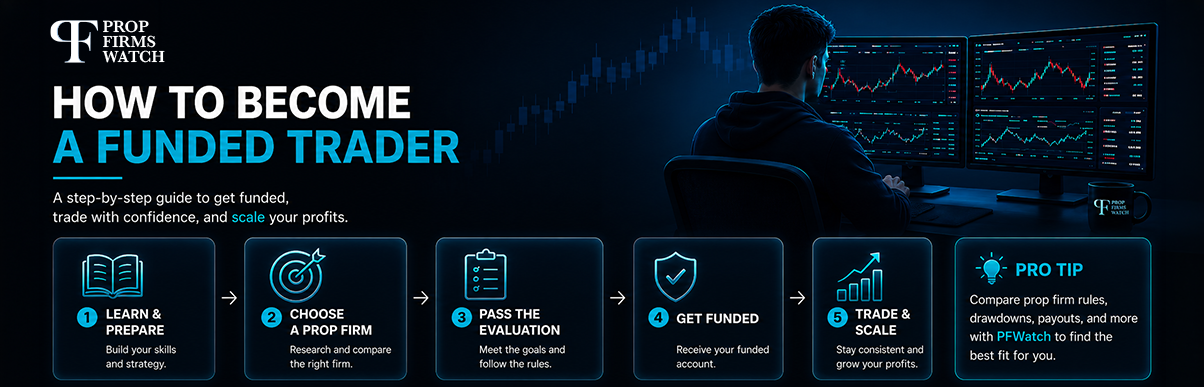
Quick Answer: How Do You Become a Funded Trader?To become a funded trader, you need to:
Pro Tip: Before purchasing a challenge or evaluation, compare prop firm rules using PFWatch. This tool makes the process easier by allowing you to identify which firm best suits your trading style. |
|---|
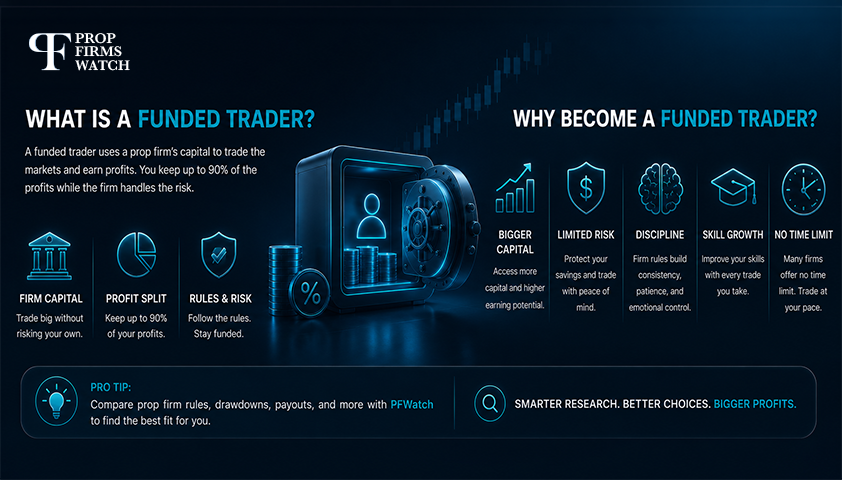
A funded trader is a person who trades the financial markets with capital provided by proprietary trading firms. Instead of using their own money as trading capital, they simply purchase a challenge from their preferred prop firm and use the capital provided to start trading.
In turn, the firm expects that the trader follows a set of rules and requirements consistently to receive a payout. The firm has a profit-splitting method, and if the trader succeeds in the challenge, profits are shared as per the agreement. Profit splits usually start from 70%, 80%, up to 90%. The firm keeps the smaller percentage while the trader takes the bigger percentage.
Becoming a funded trader comes with a lot of advantages. The biggest perk is that you get an opportunity to trade with more capital. Large account sizes equal high earning potential. Funded trading also eliminates the need to risk all of your personal savings, and this, in turn, provides peace of mind.
With funded accounts, traders are also encouraged to practice discipline and patience. Unlike personal accounts that allow traders to do whatever they want, prop firms come with rules. These rules are essential for long-term success. Traders know that if they do not stick to the rules, they will lose their accounts. This forces discipline and patience.
Another benefit is that traders work on improving their skills to improve their overall trading performance. Many prop firms these days come with no time limit, and traders can enjoy the journey without the pressure of deadlines.
Yes, anybody can become a funded trader as long as they have the knowledge, patience, discipline, and consistency that are required. Many firms do not ask for a finance degree, a specific educational background, or professional trading experience.
Instead, they focus on your ability to follow rules and manage risk effectively. In the era of smartphones and constant connectivity, the opportunity to become a funded trader is at your fingertips. However, you must have the willingness to learn and practice on a demo account, develop a working strategy, and build a strong trading psychology.
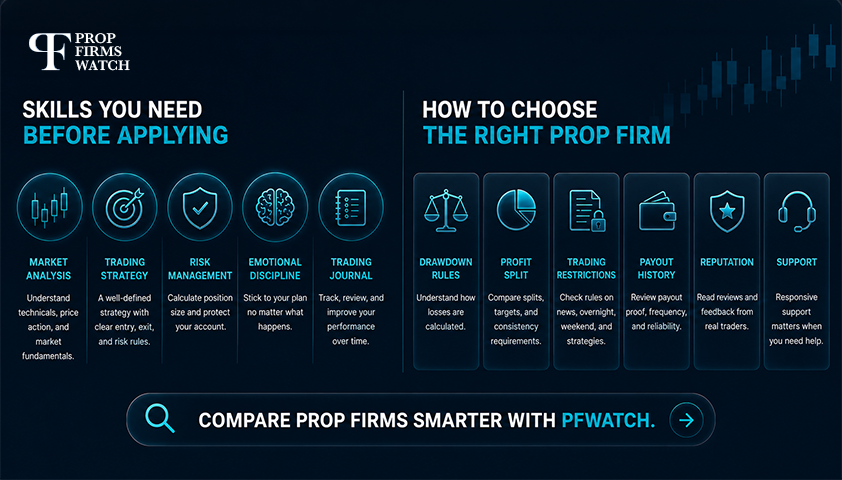
Before becoming a funded trader, there are important skills that the prop firm expects you to demonstrate. They include:
A solid understanding of Market Analysis: You must have a clear picture of how technicals work, price action, and other basic market fundamentals.
A Well-defined Trading Strategy: Create an edge for yourself to avoid strategy hoping. Your strategy must have clear entry, exit, and risk management rules.
Understanding of Risk Management: Knowing how to calculate position size can make all the difference between passing and failing a challenge.
Emotional Discipline: Your emotions can sabotage your trading. Therefore, funded traders are required to follow their plan no matter their emotions to succeed.
Well-Kept Trading Journal: With a trading journal, you can identify your mistakes and improve your performance with time.
Becoming a funded trader requires discipline, preparation, and a structured approach. By following this framework, you will increase your chances of passing a challenge and managing a funded account consistently.
Before starting your journey, you must have a clear picture of how the financial markets work. Traders usually begin by understanding the common forex trading terms, how the market moves, fundamentals, currency pairs, pip value, etc. A strong foundation in the forex industry allows you to make informed decisions anytime you are involved with the market.
Once you have understood the basics, it’s now time to build a working strategy. In trading, there are many strategies. You only need to pick one and define your edge clearly. Make sure you have entry and exit rules, a risk management approach, preferred timeframes, and sessions. It doesn’t matter whether you pick price action, breakout, or the trend strategy; you need to test your edge multiple times and stick to your rules.
Practice makes perfect. A demo account is designed to help you refine your entries and exits without risking your own money. With a demo account, you can improve your strategy, consistency, and gain confidence before investing in a funded account.
Without proper risk management, you will fail even before you get a funded account. In trading, risk management is an important skill that all traders are expected to have. You must know how to calculate position size to ensure your account does not exceed the drawdown limits set. Many traders fail because they ignore this part.
If you want to improve your trading, it is essential to keep a trading journal. Record all your trades, mistakes, wins, and reasonings. This way, you will know which setups, timeframes, and sessions work best for you. Review your journal frequently to avoid making the same mistakes.
When you are confident enough that you can manage a funded account, you can start to research prop firms. Not all prop firms are the same. The rules, profit split, trading restrictions, and requirements do vary in different prop firms.
If you are a swing trader, firms that restrict weekend holding may not be suitable for you. This is why it’s important to do thorough research on the firms before purchasing. But instead of visiting these firms’ websites individually, you can utilize PFWatch to compare prop firms side by side. This makes everything easy for you, allowing you to find a firm that matches your goals.
Once you’ve picked a prop firm, purchase an evaluation or trading challenge. Evaluations are how prop firms filter for the most disciplined, skilled traders. You’ll be required to meet a specific profit target while following all the firm’s rules. Therefore, read all the rules carefully before trading.
Follow your trading plan and pass the challenge. Do not rush the process. Instead, enjoy the execution process and learn from your mistakes. Consistency in trading is far more important than doubling your account in a few days.
After you’ve proven your discipline, consistency, and patience, you’ll receive access to a fully funded trading account. From this point on, your job is to follow your plan to maintain consistent profitability. With every profit generated from your funded account, you qualify for a payout depending on the agreed percentages.
Choosing a suitable prop firm is just as important as having a profitable trading strategy. Since different prop firms have different rules, comparing your options can help you avoid common pitfalls and find one that aligns with your trading style. Here are things you must consider when comparing firms on PFWatch;
Drawdown Rules: Drawdown rules directly affect your risk management. Therefore, understanding how losses are calculated in a prop firm is important in allowing you to pick a firm that will match your style. Some firms use a balanced-based drawdown model while others use a trailing drawdown model.
Check the Profit Split: When choosing a firm, also compare the profit split. Most firms offer between 70% to 90%. Higher profit splits shouldn’t fool you. Also, check consistency requirements, profit target, trading period, and how many phases must be completed before funding.
Check Trading Restrictions: Some prop firms have restrictions that may hinder you from reaching your full potential. Firms may restrict news trading, overnight holdings, weekend holdings, and the use of certain strategies. If you plan to swing trade, you may face difficulty trading with such a firm.
Consider Payout History: When looking at firms, check the firm’s payout history. How many payouts have they done? Have the payouts been consistent? Are there any complaints from customers? These are questions that will help you know if you are dealing with a legitimate prop firm.
Research the Firm’s Reputation and Customer Reviews: A firm with transparent rules, positive reviews, and reliable payouts is often a good firm interested in supporting its traders. Also, responsive customer support means that the firm is ready to assist you in your evaluation process.
Comparing all these details can be overwhelming. You may even miss important factors because of how tiresome the process can be. Instead, take advantage of PFWatch to make the process quick and easy. The tool allows you to see all the key features of a firm, ensuring you pick a suitable one.
Many traders fail to keep a funded account, not because they don’t have a good strategy, but because they make small, avoidable mistakes. Recognizing these traps will significantly change how you trade and improve your trading performance:
Overleveraging: Sizing wrongly can slow down your progress. You are most likely to hit a drawdown limit much quicker when you overleverage, which will have your account breached.
Revenge Trading: After a streak of losing trades, some traders normally find themselves taking other trades to recover their lost money. This usually doesn’t end well. You find yourself losing more, and now you are trapped in a cycle that ends when your capital is zero.
Breaking Drawdown Rules: A drawdown rule simply tells you that your account must not cross a certain level if you want to continue trading. Unfortunately, most traders overlook drawdown rules and find themselves breaking even the most understood rules of the prop firm. Even a profitable edge will not save you once you cross the drawdown limit.
Ignoring Economic News: This is another costly mistake. Major economic events usually trigger sharp price movements and increase volatility that could potentially wipe out your account. Always check the economic calendar before opening a trade.
Changing Strategies: If you are still strategy hoping, then getting a funded account may not be a wise decision. Stick to one strategy first, define your edge, and back-test the strategy before becoming a funded trader. There is no strategy that doesn’t experience losses.
It depends on your skill level, trading experience, and the requirements of the prop firm. Traders with a well-defined risk management plan and profitable trading strategy may pass evaluations in a few days or weeks. For complete beginners, it may take a bit of time, depending on how fast they learn and correct their trading mistakes.
However, the time it takes you to become a funded trader is of no importance. What is important is that you follow your plan consistently. Rushing the process will only give you disappointments with no real progress.
The cost of becoming a funded trader largely depends on the prop firm, funding model, and account size. Many firms want traders to pay an evaluation fee, which ranges from $50 to several hundred dollars. In some firms that fee is refunded after you successfully pass the challenge and receive a funded account.
Apart from the evaluation fee, you may also need to invest in trading education and charting software or market data if your strategy requires it. Not all these costs are necessary, but they can boost your trading performance.
The best thing to do as a trader is to test your strategy and understand a firm’s rules before investing your hard-earned money. Preparing in advance can help you save by reducing the likelihood of trying multiple evaluations or challenges.
Yes, many prop firms do not require proof of prior trading experience. However, they will test to see if you can demonstrate disciplined and consistent trading through an evaluation.
Joining a prop firm is easy if you have the funds to purchase an evaluation. You do not need to provide your academic qualifications or previous employment documents. What you need are the necessary skills to become a funded trader who can manage their account and withdraw profits consistently.
The majority of proprietary firms offer two funding models, which are instant funding and evaluation-based challenge. Each model has its own benefits and drawbacks, and the right one depends on your confidence, experience level, and trading goal.
Instant Funding: With instant funding, you get a funded account immediately after purchasing the program. It eliminates the pressure of completing the profit target set and allows you to trade right away. The downsides to this type of funding model are that it requires a higher upfront fee, and the initial account size may be smaller. With instant funding, you may also face stricter risk management rules and lower profit potential.
Evaluation Model: The evaluation model requires traders to pass one or more challenges before getting a funded account. During the evaluation, you must reach a profit target while following the firm's rules to unlock the next step. Although this funding method takes time, the evaluation accounts are normally affordable and provide access to larger trading capital and fair profit splits.
Beginner forex traders should consider starting with an evaluation, as it allows them to build the discipline and patience required for long-term success. Experienced and professional traders, on the other hand, may prefer instant funding as they already have a proven edge.
It is important to understand that no funding method is better than the other. The best one depends on your budget, experience level, and confidence. Before making a purchase decision, consider using PFWatch to compare firms’ funding models.
Unlike most professions where you know the exact amount of money you’ll earn in a month, funded trading offers no predictable monthly salaries. Earnings depend on your trading performance, profit split, account size, and consistency. Different funded traders with the same amount of capital may earn different amounts of money. This is because prop firms offer different percentage cuts on profits generated.
Sometimes earnings aren’t guaranteed. This is because in trading, not all months are the same. Some months may give strong returns, and others very little to no profit. Profitable funded traders focus on following their edge rather than trying to maximize return on every move.
Becoming a funded trader can be the best decision you ever make in your life. If you have what it takes to become a profitable trader, then the journey can be worthwhile. This is because prop firms offer larger trading capital, which means that returns are also bigger.
However, you shouldn’t be fooled by the big account sizes and attractive profit splits because becoming a profitable funded trader requires work. You must be willing to learn, practice emotional discipline, patience, and consistency to see results. Becoming a funded trader is a prime opportunity for many.
Choosing the right prop firm that matches your trading style can be very time-consuming because every firm comes with different trading rules, payout structures, and funding models. Instead of visiting every website and watching numerous videos, experienced traders use PFWatch to view important information in one place.
PFWatch allows traders to compare important rules like profit splits, drawdown model, payout frequency, supported platforms, and trading restrictions. Having all this information well put makes it easier to identify firms that suit your trading style.
Learning how to become a funded trader is more than just passing evaluations and challenges. It requires that you have a solid forex trading background, a proven trading strategy, effective risk management, and the patience to follow your plan consistently.
While prop firms offer large trading capital, your success will depend on the ability to follow the firm’s rules. Choosing a firm with transparent rules can significantly make the process easier for you. Thankfully, tools like PFWatch exist to allow traders to compare evaluations, drawdown models, payouts, and trading restrictions, allowing traders to only focus on what works for them.
The bottom line is that becoming a funded trader requires more than just having a strategy and picking a prop firm. You must also demonstrate a high level of discipline, patience, and consistency to keep and manage your funded account.
The best way is to practice consistently, define your edge well, and pass a prop firm evaluation. You can also purchase instant funding to become a funded trader.
Not necessarily. Many firms do not ask for professional experience. They will use evaluations to test you. This is why it’s important to come into prop firms prepared with the required skills.
Costs do vary depending on the prop firm and account size. Most challenges cost between $50 to several hundred dollars.
Yes. If you break the firm’s rules or exceed the set drawdown limits, your account will be terminated.
Use PFWatch to compare rules between firms. You can compare profit splits, drawdown rules, payouts, and reputation side by side. The tool can save you from future disappointments and regrets.
Disclaimer: This article is for informational purposes only and should not be considered financial advice. Always review each prop firm’s official rules before making a purchase.