October 6, 2026
What Is Scalping in Trading?
Learn what scalping in trading is, how it works, popular scalping strategies, timeframes, risks, and essential risk management tips.
View Blog
Review key prop firm rules before starting a challenge. Compare drawdowns, profit targets, and requirements across firms in one place.

July 9, 2026
Funded trading accounts have gained so much popularity in the past few years. This has sparked a lot of interest among traders, but the question is, are prop firms worth it? Imagine taking only $100 or $200 from your savings for a chance to trade a six-figure funded account. At first, it appears like a great opportunity that is impossible to ignore. But is it that simple, or is there more to the story than the marketing claims advertised online?
Proprietary trading firms, also known as prop firms, have changed the way retail traders interact with the market. Instead of spending years trying to build their personal accounts, traders can access huge amounts of capital with prop firms by investing a small amount of money.
For traders with small funds, prop firms are a great alternative to personal savings. While some traders believe prop firms are legitimate, critics argue that prop firms have strict rules, psychological pressure, and evaluation fees that make success difficult. The truth is that most of these naysayers do not have a clue how prop firms operate.
Whether a prop firm is worth it entirely depends on factors like your trading strategy, experience level, and discipline. Successful traders take advantage of tools like PFWatch to compare firms, ensuring they get one that aligns with their style. But, using a comparison tool like this can be challenging if you do not know a thing about prop firms.
That is why in this guide, we take an honest look at how prop firms work, their advantages and disadvantages, and who they are for. We expect that by the end of this guide, you will have a clear understanding of whether joining a prop firm is worth it or not.
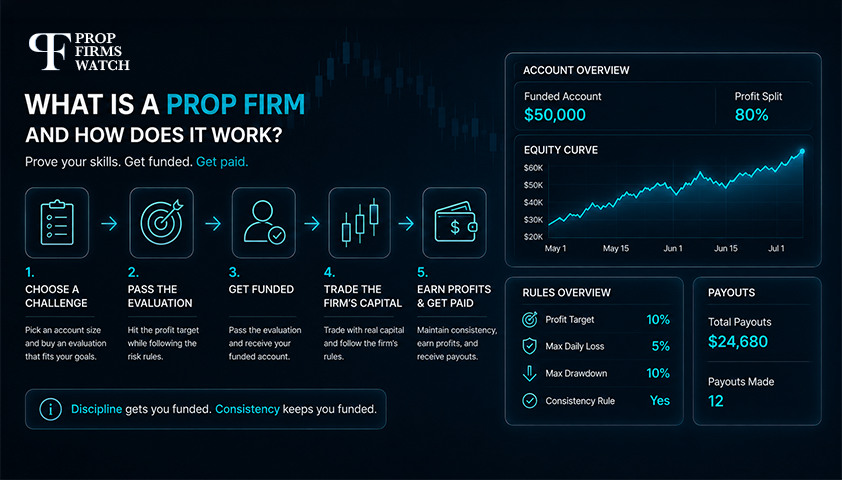
A prop firm is a company that provides access to its capital, allowing traders to trade big account sizes without using much of their own money. Traders only have to prove their skill through an evaluation. If they are successful, they get a chance to split some of their profits with the company. In most cases, the company only keeps 10% to 20% of the profit while the trader takes the rest.
This arrangement sounds fair to most traders. They get to trade with more capital, and they keep a bigger percentage of the profits they make. If you want a $50,000 account, you only need to pay a small fee to take an evaluation. If you successfully maintain consistency and apply sound risk management, the firm will provide you with your desired funded account.
Here is exactly how the process works;
Many modern proprietary firms have a system in place to determine whether the trader can manage risk responsibly and generate consistent profits. The firm will begin with an evaluation, and in this phase, there are a few objectives you must complete. You’ll be required to meet an already determined profit target while ensuring you do not go below the risk limits, like maximum daily loss and overall drawdown limit.
Most of these rules are already on the front page of the website, and you will see them when purchasing the evaluation. These rules enable firms to identify and select highly disciplined traders and filter out traders who only rely on luck.
Once you pass your evaluation, the firm will give you a funded account. With the account, you can now trade the firm’s capital and generate returns. Even though the capital belongs to the prop firm, you’ll still get a chance to earn real profits through profit splitting. If the firm keeps 20%, you get 80% of your total profits.
The main takeaway from this section is that prop firms are not there to handle large trading accounts. They are looking for disciplined traders who can demonstrate effective risk management and consistency. With the rules in place, prop companies can quickly filter for the most disciplined traders. This should tell you that passing an evaluation is only the beginning. Following the firm’s rules to remain funded and receive payouts is where the work is.
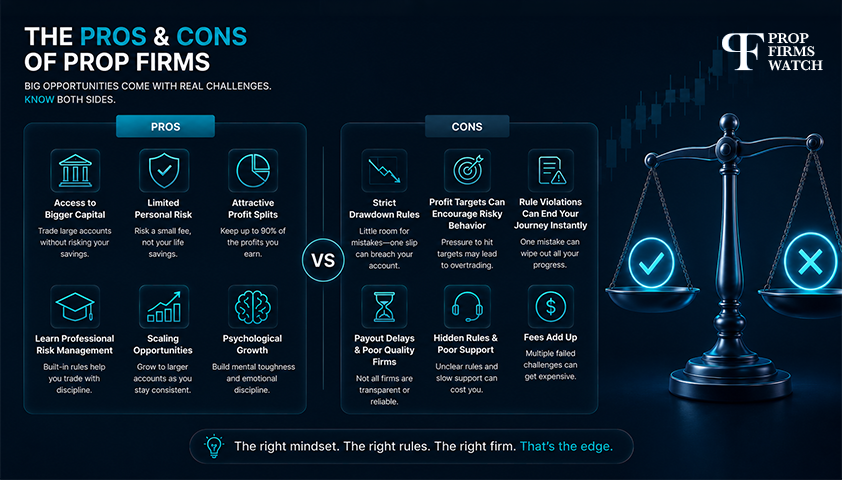
Prop firms have become the ultimate destination for traders looking to accelerate their growth. While the promise of trading a $1M funded account often grabs most traders’ attention, the real benefits go beyond simply having access to bigger capital. Here are reasons why traders believe prop firms are worth it;
This is the biggest benefit of trading with a proprietary firm. You gain access to a significantly large amount of money. Making profits with bigger capital is much easier than trying to grow a small account with relatively small capital.
The best part is that traders do not need to invest a lot of their money to manage big account sizes. Traders can choose from different account sizes provided by the company and purchase one depending on their financial capabilities. With only $100, you can get a good account size that will generate you double the amount you invested.
Trading is all about risking to gain rewards. Thankfully, prop firms can bear most of that risk. Instead of depositing your $1000 only to suffer huge losses, you take a small percentage of that money to purchase an evaluation.
Just in case you fail to pass the evaluation, you do not lose your full $1000. You only lose the evaluation fees, and you can try again until you get a funded account. Because of this, traders find prop firms attractive. They only have to define their edge, and when they are good at it, they can get huge payouts consistently. With prop firms, traders are not exposing their entire savings to the financial markets. In turn, this helps ease emotional pressure.
Another great advantage of prop firms is the fact that traders get a generous share of profits. Many modern prop firms use a profit split business model. The trader receives the bigger percentage of profits generated, while the firm keeps the smaller percentage.
The percentage you get depends on the prop firm you are using. Others use a profit split of 70/30, others 80/20, and some go up to 90/10. PFWatch can help you know the profit split percentages of a firm before signing up.
As soon as you hit the firm’s payout requirement, you can submit a withdrawal request. The firm will then notify you when you should receive your payment. The profit-sharing method most companies use is very appealing to traders, and that’s why prop firms have remained relevant throughout the years despite the critics.
Prop firms normally encourage trading discipline. Before joining, traders already know the consequences of poor risk management. Therefore, traders are forced to learn professional risk management to maintain their funded accounts.
Every funded account comes with well-written rules explaining daily loss limit, overall drawdown limit, position size requirements, among many other requirements and conditions. For beginner traders, these rules feel overwhelming, but with time, they learn that without these rules, they can’t improve their trading performance.
Even traders who stop using prop firms often carry the habits to their personal accounts. Prop firms can make you disciplined and a very consistent trader.
Traders with consistent performance can enjoy scaling opportunities with prop firms. Instead of having your account at $10,000, you qualify for larger accounts after attaining the milestones set. This ensures traders do not rely on luck, but on a proven edge. Over time, traders boost their earning potential while improving their trading approach.
Starting with a relatively small account and growing to substantially larger capital means that you’ve learnt a lot in the journey. Even with a bigger funded account, you can manage risk professionally and withdraw consistently.
Trading is not just about understanding technical analysis. It is also about improving your mental game. Greed, fear, overconfidence, and impatience are things that can negatively impact your trading, leading to poor decision-making.
A prop firm’s environment allows trades to develop emotional discipline, which directly impacts their psychology. Knowing that breaking rules could result in account termination, traders are forced to practice self-control and patience.
Traders learn to rely on their edge, and this eliminates chasing moves, revenge trading, and over-sizing. With time, this becomes a normal part of their trading strategy, and it’s what makes traders profitable in the long run.
While prop firms present exciting opportunities, they are not without challenges. The marketing often focuses on attractive profit splits and account sizes, but shortly, traders discover that staying funded could be more challenging than they thought. Knowing what obstacles may come before buying a challenge may save you both time and money;
Nearly all prop firms limit how much you can lose before your account is breached. These drawdown rules are meant to protect a firm’s capital and reinforce a trader’s discipline. But the disadvantage of this is that it leaves no room for mistakes.
For example, a trader may be very good at following his plan, but a series of losses takes him slightly below the overall drawdown limit. The evaluation or challenge is then terminated before the strategy has time to prove itself.
Solution: Read the firm's drawdown rules before engaging and risk only 0.5% of the daily loss limit. Always leave a comfortable buffer in every trade you take instead of trading very close to the daily or overall drawdown limit.
Profit targets are there to demonstrate a trader’s ability. However, they can sometimes encourage the wrong behavior. Some traders may find themselves focused on reaching the target instead of executing their plan consistently. This may push traders to increase position size, take low-quality setups, and overtrade to reach the target.
Solution: Profit target should be treated as a byproduct of good trading. Focus on execution and not the target set by the firm. In time, results will show up after you have followed your trading plan consistently.
Prop firms have several trading rules, restrictions, and requirements. If you forget one rule, your journey could end instantly. For example, if a firm restricts news trading or holding positions over weekends and you break these rules, you could have your account terminated immediately.
Even if you are a profitable trader and you end up breaking one of the rules by chance, you will lose all your profits and progress. This is a huge disadvantage for many traders, especially when the firm is not very transparent about its rules.
Solution: Before buying an evaluation, take your time to review and understand every rule. Utilize PFWatch to compare rules between firms to ensure you get one that aligns with your trading plan. With this tool alone, you can prevent costly mistakes caused by overlooking prop firm restrictions.
Not all prop firms are built with the same level of transparency. Some firms will deny you payments for trivial reasons, and some will even terminate your account for no reason. Reputable firms have a transparent payout history, and if you do not see that, you could be dealing with a scam website.
Other red flags you may notice are unexpected rule changes, slow customer support, hidden rules, etc. Researching a firm’s reputation before buying a challenge is important. You can avoid all the drama, confusion, and regrets.
Solution: Head to PFWatch to look for a proven history of timely payouts. You will discover how many payouts have been done since the launch of the firm, and you can check star ratings, including the reviews of any particular prop firm you plan to use. Everything on PFWatch is very transparent, and you can compare the information of prop firms to avoid scam and shady companies planning to siphon your hard-earned money.
Not all traders will benefit from using a prop firm account, and that is perfectly okay. Even though prop firms provide huge trading capital, they require a high level of discipline and patience. Before purchasing a challenge, you need to evaluate whether your mindset and skill level align with what the prop firm wants.
Below is a simple table that will help you quickly decide whether you are fit to trade a funded account;
Prop Firms Are Worth It for: | Prop Firms Are Not Worth It For: | |
1. | Disciplined traders who follow their edge consistently and respect risk management. | Gamblers who oversize and rely on luck. |
2. | Experienced demo traders who have spent time testing their strategy and have been profitable on simulated accounts. | Complete beginners who are still looking for a trading strategy and learning risk management/market structure. |
3. | Traders with small funds who have the skill and are looking to scale. | Emotional trades who revenge trade, chase trades, and let emotions interfere with their progress. |
4. | Traders with proven consistency. They understand that their edge will play out over a large number of trades. | Traders without a plan and enter trades impulsively. |
Proprietary firms do not create professional or profitable trades. They simply amplify the abilities of those trades who have a solid foundation. If you can manage risk effectively, follow your plan, and maintain patience during stressful market conditions, then prop firms can boost your trading performance significantly.
On the other hand, if you are still struggling with emotions, getting a prop firm could be a mistake because you will lose all your money, and that may disappoint and frustrate you.
Yes, many prop firms are legal businesses that support traders. They allow traders to gain access to large trading accounts, allowing them to get huge payouts. With PFWatch, you can compare various firms and gain access to all the information you need without scrolling through pages.
Many prop firms want traders to first complete an evaluation by meeting the targets set. Once a trader passes, they receive a funded account, trade the firm’s capital, and earn a profit through the profit-sharing agreement. To stay funded, traders must continue following the firm’s rules and demonstrate disciplined trading.
Yes, but they first need to have a proven edge that works as well as a good risk management strategy. If you are a complete beginner, do not rush to buy a challenge; you may lose all your investment. Use a demo account to practice first.
Reputable companies pay the traders the promised share of profits. Using a prop firm with a strong history of timely payouts will save you a lot of trouble in the future.
That depends on your experience and trading goals. Prop firms offer bigger trading capital with lower financial risk, while personal accounts allow you to keep 100% profit and offer complete freedom.
So, are prop firms worth it? The answer cannot be a simple yes or no. This is because prop firms are like a tool, and just like any other tool, their value relies on who is using them and how.
Traders with an established strategy, effective risk management, and discipline find prop firms to be an excellent way of improving their trading and overall returns. With prop firms, they can scale faster and access opportunities that might take them years and years to achieve.
On the other hand, traders who are looking for quick ways to get rich may struggle a lot with funded accounts. This is because they require emotional control and a high level of discipline and consistency. Strict trading rules will definitely hinder you if you are not prepared to follow what’s required by most prop firms.
As a trader, you should always examine the realities of trading with funded accounts. Ask yourself whether you have a proven strategy and the patience to follow prop firm rules. If you're ready, go to PFWatch, compare firms, read rules, and research their payout history to find a prop firm that matches your expectations and style.
Always keep in mind that getting funded does not guarantee profitability. It is the start of new responsibilities. The same habits that helped you get funded are the same habits that will keep your account and improve your returns.
Disclaimer: This article is for informational purposes only and should not be considered financial advice. Always review each prop firm’s official rules before making a purchase.