October 6, 2026
What Is Scalping in Trading?
Learn what scalping in trading is, how it works, popular scalping strategies, timeframes, risks, and essential risk management tips.
View Blog
Review key prop firm rules before starting a challenge. Compare drawdowns, profit targets, and requirements across firms in one place.
July 6, 2026
You’ve signed up for a challenge. You are managing risk, following rules, and trying to improve your portfolio. But deep down, there is a question itching you: Does this firm want me to pass, or does it want to profit from my failure?
It is a fair question.
In the last few years, the proprietary trading industry has snowballed. However, traders have witnessed most of these firms come and go without a warning. Payouts have been denied, and trading rules have changed overnight. This has created a lot of doubt around this industry. Being able to answer the question “How do prop firms make money?” will not just satisfy your curiosity. It will also allow you to know whether your prop firm has a sustainable business model, ensuring you trust it with your precious time and money.
Many prop firms generate their revenue primarily through trader profit splits, evaluation fees, and additional sources of income like commissions, spreads, and partnerships. These business models vary significantly between companies. A firm that solely depends on commissions and failed challenges is very different from one that has multiple revenue streams.
Knowing and understanding how every prop firm’s business model works will change how you view the industry. You will no longer feel like the rules, requirements, and restrictions are obstacles. Instead, you will understand why these rules exist in the first place and how you can make them work for you.
This article will shed more light on the major prop firm revenue streams. It will compare the traditional prop firm vs. retail prop firm business model and explore the sustainability question, ensuring you understand what all this means for your money.
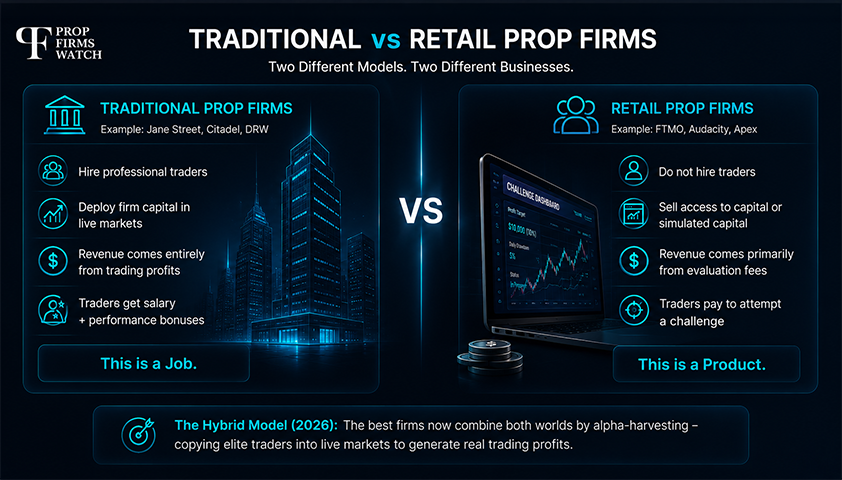
A common mistake many traders make when asking “How do prop firms work?” is thinking that all proprietary firms operate similarly. The reality is that the traditional prop firm and retail prop firm can almost be considered two different industries, as they are very distinct from one another.
Understanding the difference is important because the prop firm revenue model 2026 depends on the approach you are looking at.
Some of the few traditional prop trading firms include Jane Street, Citadel Securities, and DRW. These industries follow the original business model. They find professional traders, market analysts, and quantitative researchers and provide comprehensive training. The firm’s capital is then deployed directly into the live market.
This business model is very straightforward. They simply make money when their trading operations work in their favor. Traders at traditional prop firms are not customers but employees. They get a salary and performance-based bonuses depending on the profits they generate for the firm. In other words, there are no evaluation or challenge fees. There are also no payouts because the agreement is based on employment.
The key takeaway in this traditional prop firm vs retail prop firm comparison is that traditional industries only generate their revenue when their traders perform in the market.
The retail prop firms operate under a very different model. Instead of hiring traders, they sell them access to funded accounts through a challenge process. A trader will pay an upfront fee for a challenge or evaluation. They will then follow a set of rules over a period of time while generating consistent results to receive a payout.
This prop firm business model allows firms to generate income through the challenge accounts. A trader’s performance does not entirely affect the company in any way. Whether a trader becomes profitable or not, the firm will still collect its revenue.
Now, this model may sound unfair, but there are things to be considered. The evaluation fee paid upfront by traders is used by these firms to improve platform infrastructure, cover the latest technologies, liquidity arrangements, fast customer service, and other operational expenses.
With this information, traders should pay attention to what the firm offers. Does the firm offer the best trading platform, fast customer support, or is everything always stagnant? You do not want to be involved with a firm that delays execution or suddenly widens their spreads.
One of the most interesting developments in the prop firm revenue model 2026 is the arrival of hybrid retail firms. These firms are focused on generating income from actual market performance. Instead of relying on evaluation fees, the companies sort through their pool of best-performing traders. They then mirror or copy their strategies while using risk management systems to boost their yearly returns.
This process is known as alpha harvesting. It allows prop companies to generate a second income stream from genuine profits. Unlike most firms that only focus on themselves, this positive outlook allows firms to focus, identify, and support real talent in the market. A firm that succeeds with its best traders will have all the reasons to ensure that its traders get all they need to double their performance in the market.
The real question is not whether the traditional, retail, or hybrid model is better. The imperative question is whether the firm’s model offers a sustainable approach where both the company and the trader can succeed in the long run.
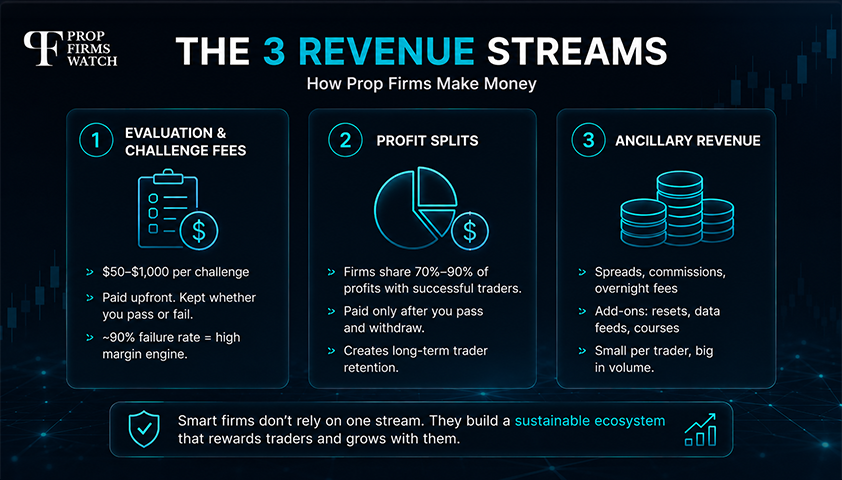
Do prop firms make money from fees? This is one of the most critical questions asked by most traders, and the honest answer is yes. The main revenue stream for many retail prop companies is challenge and evaluation fees. Here is how prop firm challenge fee revenue works;
The process is pretty straightforward. A trader interested in trading with a funded account purchases a prop firm challenge. It may cost $50 up to $1000, depending on the company and the account size. The fee is paid before the account is issued. Whether the trader fails, quits, or passes the challenge, the company keeps the fees.
Most prop firms avoid discussing this bit because they want their traders to think that all will be smooth when they start trading. However, a firm that cares about its traders prepares them for any surprises. Once you purchase an evaluation, you will be executing in a simulated trading environment. The firm uses part of the fees to lease technology and third-party platforms that will support your trading, and they keep the rest of the profits.
This is a controversial truth that causes discomfort and challenges many held beliefs. Traders think that 90% of traders fail because they do not understand their strategy. But the truth is stranger, the prop firm 90% failure rate is a major part of how the economics work.
Passing a prop firm evaluation is widely considered challenging, and only a minority of traders successfully complete the process. Now, consider this example;
A prop firm sells 10,000 challenges at $200 each. This means that the total revenue generated is $2 million. Out of the 10,000 sold, 9,000 fail their evaluations and receive no payout. The firm now has $1.8 million to keep and can use it for technology expenses, operating costs, advertisements, and to pay the 1,000 successful traders (the 10%).
One perk of trading with prop firms is that most of them usually offer a discounted retry, also called a reset fee. Prop firm reset fees usually range from 20% to 40% cheaper than the original price. This is a second chance that allows traders to continue with their initial challenge. But is this really a good thing?
Many traders will say no because profit targets, rules, and market uncertainty remain the same. Aside from that, the infrastructure, technology, and customer acquisition costs have already been used from the first sale. This makes the prop firm reset fee business model another high-yielding revenue stream for the company.
Evaluation fees are so profitable for nearly all firms. This is because the cost of issuing a simulated trading account is nearly zero. Platform licensing, risk management systems, payment process, and customer support all require a comparatively low investment.
This means that for every challenge sold, prop firms generate a good amount of revenue. It is the reason why many firms heavily invest in influencer sponsorships, affiliate marketing, and promotional discounts. Boosting challenge sales directly impacts their cash flow.
The majority of prop firms advertise a challenge fee refund. They promise that traders will get their full invested amount after they have successfully completed the challenge. Upon the first payout, the trader receives the fee. On the surface, the evaluation appears to be free, but the psychology behind it is complex.
The fee is paid upfront, and the firm benefits from the liquidity during the challenge phases. The fee is only returned to the traders who complete the evaluation successfully, and the majority who lose do not get anything. The refund fee is never misleading. The firm usually honors their promise, but traders must know that it is a conversion tool.
Instant funding accounts eliminate the evaluation phase but increase their fees. These firms price the risk of giving access to an instantly funded account without filtering traders through the required challenge.
Traders who want to get instant funding pay extra to start trading immediately. But the firm is compensated for the likelihood that most traders will fail to keep up with the required risk parameters. The model is different, but the principle remains the same.
Understanding why challenge fees are the primary source of income for many retail prop firms enables trades to carefully evaluate firms before purchasing challenge accounts. A transparent firm interested in the well-being of its traders will clearly explain terms and conditions without hiding other details. With these firms, traders get first-hand information on the fee structure, reset pricing, refund conditions, and payout details.
This is where comparison tools can come in handy. PFWatch allows traders to gain access to high-quality information before paying for evaluations. With the tool, traders can compare refund policies, reset costs, payout history, and fee structure of different prop firms, ensuring they find a company that works for them. PFWatch tracks all these things effortlessly, saving you time, money, and future regrets.
As a trader, focus on the bigger picture. The evaluation fees being charged by prop firms shouldn’t be a hindrance. The most important question should be “Does the prop firm’s revenue model create a sustainable environment that allows traders to scale up?”
Not all challenge fees are created equal. While one prop firm may charge a lower entry fee, another may offer better refund policies, lower reset costs, or more transparent evaluation rules. Looking beyond the initial price can help you understand the true cost of becoming a funded trader.
With PFWatch, you can compare challenge fees, refund policies, reset costs, and evaluation requirements across multiple prop firms, helping you choose a firm that matches your trading goals.
Ask traders how prop firms make money, and you’ll hear many say through the profit split. It is hard to doubt that if you are not familiar with the prop firm's business model. After all, prop companies advertise attractive payouts where traders can keep 80% to 90% of their profits. But this is not as simple as it sounds. Here is exactly what happens;
The mechanism behind profit sharing is not only about the percentages. It is also about understanding where the money comes from. Consider Sam a profitable trader who generates $5,000 in profits on a $100,000 funded account. With an 80/20 profit-sharing agreement, Sam receives $4,000, and the firm retains $1,000.
A prop firm profit split explained in this manner may make 20% seem insignificant for the firm, but remember these numbers multiply with more consistently profitable traders. This means that the prop firms generate substantial income from sharing profits with traders. However, the real question should be, how do prop firms pay traders? The answer is that it entirely depends on the type of account model the prop firm operates.
The two common ones are: the simulated account model and the live capital model. Let’s have a look at the simulated vs. live prop firm account;
The Simulated Account Model: The Most Common Structure
The simulated account is the most common one and is used by several prop firms in the industry. For these prop firms, their funded account is normally a simulated environment designed to mirror live market conditions. Instead of exposing the firm’s capital, they simulate everything and pay profitable traders using other revenue streams.
Assuming a trader earns $5,000 in a simulated account. It simply means there is no corresponding $5,000 profit that has been generated from a live market. The firm retains its share on paper, but the cash that is used to pay a trader comes from other income pools, which may include evaluation fees, commissions, and reset fees.
Most reputable firms keep their promise and pay consistently. However, it’s important to understand that in simulated trading accounts the payouts do not come from the market but from the firm’s business revenue.
Very few prop firms use this approach of allocating genuine capital through institutional liquidity. In this account model, the performance of a trader directly affects the profits and losses of a company. If a trader gains a return of $10,000, the 20% the firm gets is from the real market.
Audacity Capital, among few other prop firms, practices this approach, which is almost similar to traditional proprietary trading. The company’s incentives are linked with the trader’s success. With such firms, they focus on supporting their traders to ensure their business thrives.
A rising trend in the industry is the prop firm alpha harvesting. It’s a hybrid approach or model that is between simulated accounts and live funded accounts. Instead of moving traders into a fully live funded account, the firm analyzes their most profitable consistent traders and copies their signals into a live account.
Traders continue using simulated accounts and get the agreed-upon profit split, but on the other side, firms earn additional revenue from copying the most consistent traders. This is a great model because it generates another source of income for prop firms. Over time, you find prop firm alpha harvesting reduced dependency on selling evaluations and, in turn, focus on creating a suitable environment for their traders.
A 90% profit split does not always mean a better deal. Prop firms always compete by promoting a higher and higher split. Unfortunately, most traders fall for this, not understanding the reasons behind the 90% profit split.
A 90% split from a simulated account that has been largely funded by evaluation fees is a completely different thing from an 80% payout generated from a live market. A more intelligent question is not “How much profit do I keep? It should be “What is the business model supporting the firm’s payout?’
One of the most overlooked things in trading is the type of account model prop firms use. When traders are looking for a suitable proprietary firm, they do not check whether the firm operates on a simulated or live capital account.
This information could help a trader understand how the firm funds its traders. Is the firm dependent on challenge fees, or does it have other revenue streams? PFWatch allows traders to find all this information without scrolling through pages. Traders can quickly compare information about different prop firms, ensuring they know whether they are working with simulated or live accounts.
When traders understand the basis behind the high advertised profit split, they can avoid falling into certain traps. A high profit split is attractive, but is the firm sustainable, and is it interested in ensuring the success of its traders?
A higher profit split doesn't always mean a better opportunity. It's equally important to understand whether the firm pays traders consistently, uses live or simulated accounts, and has a sustainable business model to support long-term payouts.
PFWatch lets you compare profit splits, payout history, funding models, and trader reviews so you can evaluate more than just the advertised percentage.
Prop firms do not depend only on challenge fees and profit split to generate revenue. There is also another income stream that most traders are not aware of. Every time you click buy or sell, you generate income for the prop firm. This revenue is usually earned quietly in the background without most traders realizing it until their profits aren’t adding up.
Understanding this stream of income is important as it directly affects your profits. They also reveal another side of the proprietary business model that new traders aren’t familiar with.
The difference between the bid and the ask price of an asset is what is referred to as the spread. Institutional liquidity providers normally offer very tight spreads. A pair like EUR/USD can sometimes have a spread of 0.0 to 0.1 pips under favorable market conditions. However, this spread may change in retail prop firms that route their services through retail brokerage infrastructure, offering a spread of 0.5 to 1.2 pips on the same pair.
The markup is this difference between the raw institutional spread and the spread being offered. When that spread markup is multiplied across millions of trades that happen every month, the small difference becomes a substantial source of prop firm spread revenue. The firm generates this income solely from trading activity, and they earn it regardless of whether a trader wins or fails.
Apart from spread markups, commission can also scale up quickly. Many firms charge a fixed commission rate starting from $3 to $8 per standard lot size. What appears to be a small fee can make a meaningful income stream for the company.
Assuming a prop firm has 1,000 active funded trades. Each trader executes 50 standard lots and pays $3 to $8 per lot in commissions. It means that the firm is making approximately $150,000–$400,000 every month from commissions alone. This simple prop firm commission explained requires looking beyond the individual trader’s cost.
Another lesser-recognized business approach of the retail proprietary firm is the broker rebates. Many firms operate via a partner broker rather than linking themselves directly to institutional liquidity providers. The arrangement requires that the broker pay the prop firm a rebate, which is simply a percentage of the spread, commission, or trading volume.
The prop firm broker rebates produce a volume-based business model, where the firm generates more revenue the more traders trade. Most legitimate investing companies use volume sharing agreements without having a conflict of interest. However, traders should know that it may affect how frequently they are required to execute trades.
While commissions and spreads are the major revenue sources, some prop firms add other income sources such as;
Platform Fees: Usually range from $0 to $50 per month.
Inactivity Fees: Normally around $20–$80 per month.
Market Data Fees: For professional data feeds.
These charges may also look small, but over time they significantly add up when implemented across multiple accounts.
New prop firm traders focus all their time on comparing profit splits while paying zero attention to the conditions set. A 90% profit split is useless if it is paired with wider spreads, high commissions, and several other account charges. It may, in fact, be less profitable than the 80% profit split.
Understanding hidden fees prop firms have is just as important as understanding the requirements of the firm. The combination of commissions, spreads, data costs, and other recurring charges is the real cost of trading. Therefore, knowing the real revenue streams of a prop firm will allow you to understand the advertised payout percentage.
Many firms that generate their earnings from live market activity, trading volume, and institutional liquidity agreements may have a sustainable business model compared to those relying on challenge fees only. A good example is Audacity Capital, which is a firm that operates closely with an institutional liquidity provider and uses live capital. The firm has lower spread markups, but largely relies on actual market profits and trading volume.
We have looked at the three main revenue streams for prop firms, but what does this really mean for traders? Traders must be very careful when choosing a prop firm. Instead of only paying attention to the payout percentages. Ask these crucial questions;
What commissions will I pay?
What is the average spread for this firm?
Does this firm benefit from trading volume or broker rebates?
Will I be using a live account or a simulated account?
These questions can help in the process of prop firm selection, ensuring you get the best offer for an affordable price. Tools like PFWatch can make the process enjoyable and easy. It allows traders to compare firms in regard to commissions, spreads, and other recurring costs. Rather than visiting all webpages, you simply get all the information you need by being on just one page.
Trading costs can significantly affect your profitability over time. Comparing spreads, commissions, platform fees, and other recurring charges helps you understand the real cost of trading with each prop firm.
With PFWatch, you can review trading costs, platform support, commissions, and other important conditions side by side before purchasing a challenge.
After looking at every prop firm revenue stream, the key takeaway is that many firms do not rely on one source of income. They have multiple revenue streams where trading costs, evaluation fees, and other recurring charges create the overall business.
This table provides a complete prop firm business model breakdown and answers the most crucial question: What are the main prop firm revenue streams?
Revenue Stream | Importance | How It Generates Revenue |
Challenge/Evaluation Fees | Primary | Traders pay an upfront fee of about $50 to $1000 before trading. The cost of issuing a simulated account is very low, which gives firms high returns. Since 90% of traders fail these challenges, it makes it the number one source of revenue stream for many prop firms. |
Reset/Retry Fees | Primary | When traders fail their evaluation, they are offered another chance to continue trading with the account. The reset fee is normally 20 to 40% of the original price. The retry fee is a high-margin revenue stream since the firm uses the same infrastructure to support the account. |
Profit Split Retention | Secondary | Many prop firms retain 10 to 30% of the profits generated by traders. Firms can generate a significant amount of returns, but that largely depends on the number of profitable traders the prop firm has. |
Spread Markups + Commissions | Secondary | Every click of a button generates potential earnings through spread markups, broker rebates, and commissions. The revenue scales up with trade volume.
|
Alpha Harvesting | Emerging | Firms have come up with a new approach to generating revenue, where they copy from their best traders. The firm keeps all the profit generated from the live markets without depending entirely on evaluation and challenge fees. |
Platform and Inactivity Fees | Minor | Market data, inactivity fees, and monthly software range from $0 to $80 per month. Individually, it looks small, but over a thousand accounts, it becomes significant. |
This quickly lists how prop firms generate income, starting from the most important to the least important. The main point is that not all revenue streams carry the same weight.
Understanding how prop firms generate revenue is only one part of the decision-making process. The next step is comparing how individual firms apply their rules, payouts, and funding models in practice.
PFWatch brings this information together in one place, allowing you to compare prop firms based on business model, drawdown rules, payout reliability, fees, and overall transparency.
After knowing how prop firms make money, the question is no longer about revenue but about incentives. Are prop firms legit in 2026, or is the system designed to make traders lose money? The truth is that it depends on the firm.
While some firms are focused on creating a thriving relationship between the firm’s profitability and the trader’s success, others only focus on selling new challenges. Transparency is what makes all the difference in this industry.
The most logical argument in favor of proprietary firms is that it gives traders access to huge amounts of capital they would not otherwise be able to get. A trader who wants to invest $100,000 in the market can simply pay a small fee and gain access to such an amount of capital.
The firm provides rules and reequipments, including drawdown limits, profit targets, position sizing, and payout conditions. Many established firms keep their promise, support their traders, and issue payouts on time.
From this point of view, prop firms are viewed as legitimate businesses looking to support traders. Just like the traditional prop firms that use testing, interviews, and trading to find real talent, the modern prop firm uses challenges to filter for risk management, discipline, and consistency.
This makes the existence of evaluation/challenge fees justifiable. Paying these fees does not automatically mean the prop firm is a scam, which is why the question “Are prop firms a scam?” cannot be answered with a simple yes or no.
The proprietary industry also faces criticisms that are valid. Some traders will argue that a firm which generates most of its revenue from failed challenges will create rules that do not allow traders to pass. The most debated example is the trailing drawdown model. Traders feel that firms that use this model could hinder their long-term success in the market.
The static drawdown model usually remains fixed and is easier for traders to manage. On the other hand, a trailing drawdown moves up as the account balance increases. Over time, traders realize it’s more difficult to maintain an account with a trailing drawdown.
Other traders argue that the presentation of a reset fee is a controversial practice. Immediately the account is violated, a reset fee notification appears: “reset your account today at a discount.” The firm probably knows that the trader is disappointed, frustrated, and has a desire to recover the losses, but still will offer another chance to continue.
The discounted fee may appear as a better deal, but if you think about it, it appears as an opportunity to exploit a trader’s emotional state. The outcome usually remains largely unchanged from the original challenge.
The question shouldn’t be “Is the prop firm model fair?” It should be “Which prop firm creates an environment where traders and the company can succeed together?” This checklist should be your guide whenever you think of purchasing a challenge;
Verify Real Payout History; Marketing claims can be paid for. Traders' experience, verifiable payout records, and a consistent history can provide evidence of prop firm payout reliability.
Look for Longevity: For how long has the firm been in operation? Firms that have lasted more than 3 years in the industry can fulfil their obligations without disappointing traders. Longevity simply signals stability.
Examine Their Revenue Model: A prop firm that has multiple income streams may have a balanced business approach, unlike one relying solely on challenge fees. Diversified sources of revenue mean that the company has less dependence on the rate of failure.
Know the Drawdown Rules: Before purchasing the challenge, understand the drawdown rules. Is it a trailing or static drawdown model? If it's trailing, get more insight into how the limit changes as the account increases.
Read the Rules; They should state all their rules clearly. Any vague language could be a warning sign that will have your account terminated before you pass the challenge. Trustworthy firms that aren’t interested only in evaluation fees are very transparent. They clearly state their profit target, drawdown rules, requirements, restrictions, account termination conditions, etc.
The straightforward conclusion is that prop firms vary wildly in how they operate. The legitimate prop firms have honest, transparent rules, diversified revenue streams, and consistent payout history. The scam firms are the ones that change rules frequently, depend only on new challenge sales, have unclear payout history, and make it difficult for traders to withdraw money.
PFWatch exists to make the process easier for traders. The tool tracks rule changes, payout history, drawdown models, and longevity transparency. This allows traders to eliminate their doubts about prop firms and rely on the best ones, which are geared towards making traders profitable.
Many traders usually stop at the marketing page, not realizing there is more on the other side. PFWatch takes you to the other side, allowing you to compare firms and find the ones that have an alignment of incentives.
After understanding how prop firms operate, the most important thing is to look at what prop firm business models mean for traders. Every rule, agreement and conditions set are part and parcel of the company’s business model. Here’s what you should know:
The Rules are the Business Model; The architecture of the business model is built on the rules. In other words, the rules are the business model. From consistency requirements, maximum drawdowns, daily loss limits, to trading restrictions. All these serve as a core revenue framework for the firm. They are not obstacles placed to make you fail; instead, they are a risk management tool that helps filter for discipline, consistency, and seriousness.
Treat Reset Offers Like a New Financial Decision; Do not be quick to throw away your money in the market. Treat every payment/purchase as a new financial decision. Reset fees are a high-margin product on the shelf. Therefore, take your time to understand why you failed the challenge before rushing for the tempting discounted prices. Most times, the trading outcome remains the same because you did not fix your previous mistakes.
A High Profit Split Should Distract You from Payout Reliability; The 90% profit split reveals itself as one of the biggest prop firm red flags business model. Many firms advertise the 90% profit split knowing very well that traders will fall for it. However, this is meaningless if a firm lacks a concrete payout history. A company with a 75% profit split and a strong reputation presents a much better opportunity.
Calculate the Real Cost of Trading: A new trader only looks at challenge fees, profit split, and ignores all the other things like commissions and spreads. Every time you open a position, there is an amount that is deducted. These could compound very fast, reducing your overall returns. When comparing firms, look for the ones offering tighter spreads and low commissions to boost your performance in the market.
Choose Firms with Diversified Revenue: The best method of how to choose a prop firm 2026 is to examine its revenue streams. With that information, you can be able to determine if the firm is aligned with your success. A firm highly dependent on the failure of its traders is obviously not a suitable one.
Find prop firms that generate income from multiple different sources. If a firm operates using live accounts, it will want its traders to succeed so that they can get real profits from live markets. These companies are more trustworthy, and their business model allows for the growth of both the company and the traders.
Understanding how prop firms make money is valuable—but applying that knowledge when choosing a prop firm is even more important. Every firm has its own funding model, trading rules, fee structure, and payout process. Comparing them manually can take hours and still leave important details unnoticed.
PFWatch simplifies the research process by bringing key information from leading prop firms into one place. Instead of relying on marketing claims alone, traders can compare firms using transparent data and objective insights.
With PFWatch, you can compare:
Challenge and evaluation fees
Profit splits
Reset and refund policies
Drawdown models
Payout history
Trading platforms
Trading rules
Account sizes
Firm longevity
User reviews and ratings
Whether you're choosing your first prop firm or switching to a new one, PFWatch helps you make informed decisions based on facts rather than marketing.
Many prop firms make money through various revenue streams, such as evaluation and challenge fees, profit split, reset fees, commissions, spreads, broker rebates, and many other ways.
The truth is that it depends on the prop firm’s business model. A prop firm that generates income from challenge fees earn when many traders fail. Reputable companies, on the other hand, require profitable traders to boost their returns and attract more customers.
The challenge fee is mostly non-refundable if you fail the challenge. The firm keeps the money whether you pass or fail, but they will give you a discounted reset offer to continue with the challenge. Most times, the results remain the same as the original outcome.
The majority of prop firms use a simulated account, while very few operate in a live market. Knowing the type of account you are using can help you understand the firm’s business model.
This is a new strategy where the prop firm identifies its best traders and copies their trading signals into the live markets. The prop firm then generates another form of revenue, allowing the company to not only depend on challenge fees.
Firms using simulated accounts pay their traders from their business revenue streams, which may include challenge fees. On the other hand, firms that use live capital pay traders from the actual trading profits.
Many prop firms are not regulated because they do not hold traders’ investments and also do not provide direct market access. This means that traders must do their due diligence to understand and know a firm’s business practices, payout history and ownership transparency.
A broker provides access to the financial market and earns income through commissions, spreads, and other fees. A prop firm provides access to a funded account and earns revenue from evaluation fees, profit split, and other services. A broker executes trades, and a prop firm evaluates, funds, and manages traders.
The prop firm has a legitimate payout history, transparent rules, and multiple sources of income beyond the normal streams, which are evaluation and challenge fees.
No, the prop trading industry is not a scam. We have firms that operate with the highest degree of honesty, openness, and clarity. These firms have been in the industry for years and operate with very clear rules. The industry also has other firms that change rules frequently, do not have a history of clear payouts, and rely heavily on new challenge sales.
After looking at the ins and outs of the prop firm business model, traders can now look beyond the marketing and examine the industry with clear expectations. Prop firms generate income from challenge fees, followed by profit splits and other additional revenue sources like commissions, spreads, and ancillary fees.
This does not make the business model unfair. It reveals the financial tie between the prop firms and the traders. Smart traders do not choose prop firms based on their account size and profit split. They look for their revenue streams, payout history, rule transparency, and incentives that align the company's success with that of its traders.
Prior to paying any challenge fees, visit PFWatch. Compare firm rules, reliability, payout records, and then make a decision based on evidence rather than relying on marketing materials. Now that you understand what you need in a prop firm, PFWatch makes it easy for you to confirm those things, ensuring you enjoy your trading journey.
Disclaimer: This article is for informational purposes only and should not be considered financial advice. Always review each prop firm’s official rules before making a purchase.