October 6, 2026
What Is Scalping in Trading?
Learn what scalping in trading is, how it works, popular scalping strategies, timeframes, risks, and essential risk management tips.
View Blog
Review key prop firm rules before starting a challenge. Compare drawdowns, profit targets, and requirements across firms in one place.
October 15, 2026
Choosing between MT4 vs MT5 may significantly influence how you monitor, analyze, and execute trades. Both platforms are popular among forex traders and are available on the majority of online brokers’ websites or in proprietary trading firms.
Even so, their functionality mainly varies in terms of available tools, technical indicators, and order execution types. Their differences can be crucial for any trader looking to trade using the platforms and those actively working on their strategies.
Therefore, when deciding between MT4 vs MT5, you should go beyond the given interface and focus on the broader context of trading instruments, indicators, technical analysis tools, and EA availability. One should also consider whether a chosen proprietary trading company offers MT5 or MT4 services.
Overall, both platforms cannot be ruled out as better or worse options since their impact on a trader’s performance largely depends on personal preferences and the set of available instruments. That is why in this article we will look at both trading platforms individually to help you understand which one is suitable for your trading approach.
MetaTrader 4 MT4 is a trading platform created in 2005 by MetaQuotes. This platform mainly focuses on foreign exchange market trading and offers charting tools, technical indicators, drawing, and trade management tools that allow traders to study the behavior of different currency pairs and make transactions.
The program also allows users to employ expert advisors or automated trading algorithms. Because of its wide application and various custom indicators and trading robots, MT4 still attracts lots of forex traders.
The MT5 trading platform was launched in 2010 as a further development of the concept, which is the possibility of trading on a wider range of assets. Depending on the prop firm offering it, it covers forex, stocks, indices, commodities, and other assets.
MT5 has more technical indicators, order types, and advanced strategy-testing tools. These factors are especially attractive to active traders looking to analyze the market in greater depth and diversify their activities.
While the two platforms have a similar interface, they are not interchangeable, as they have been built on different underlying technologies. MT4 uses MQL4, while MT5 uses MQL5 for automated trading tools. As a result, expert advisors and custom indicators written in MQL4 will not function on MT5 without conversion, and vice versa.
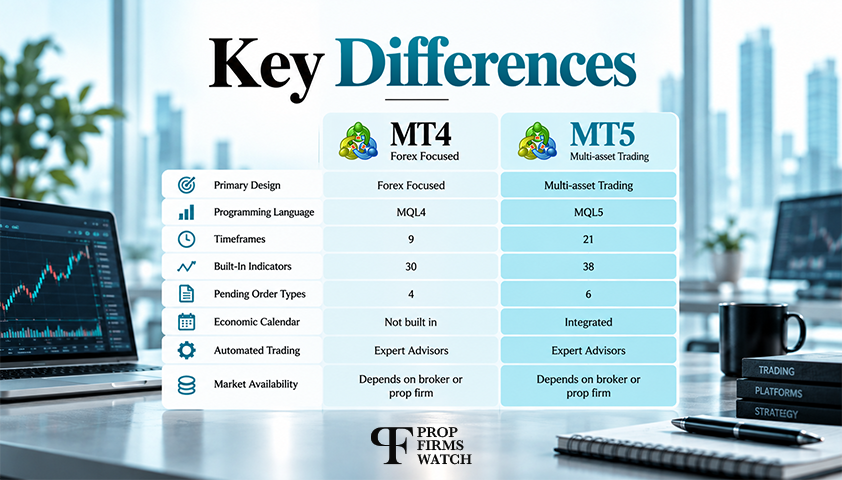
The MT4 vs MT5 differences are essential as they allow traders to understand and know the most suitable platform for their trading strategy. While both solutions provide charting, order execution, and automated trading capabilities, MT5 has additional analytical tools and multi-asset functionalities.
Feature | MT4 | MT5 |
Primary Design | Forex Focused | Multi-asset Trading |
Programming Language | MQL4 | MQL5 |
Timeframes | 9 | 21 |
Built-In Indicators | 30 | 38 |
Pending Order Types | 4 | 6 |
Economic Calendar | Not built in as a native platform feature | Integrated |
Automated Trading | Expert Advisors | Expert Advisors |
Market Availability | Depends on the broker or prop firm | Also depends on the broker or prop firm |
One of the main differences is the spread of analytical tools. MT5 provides more built-in time frames and indicators, offering traders more room for analyzing price movements at different time intervals. The software’s built-in economic calendar can also be used to identify upcoming events that could trigger market volatility. However, more features do not necessarily mean better trading performance. The appropriate choice depends on which tools the trader needs and whether the company supports the selected platform.
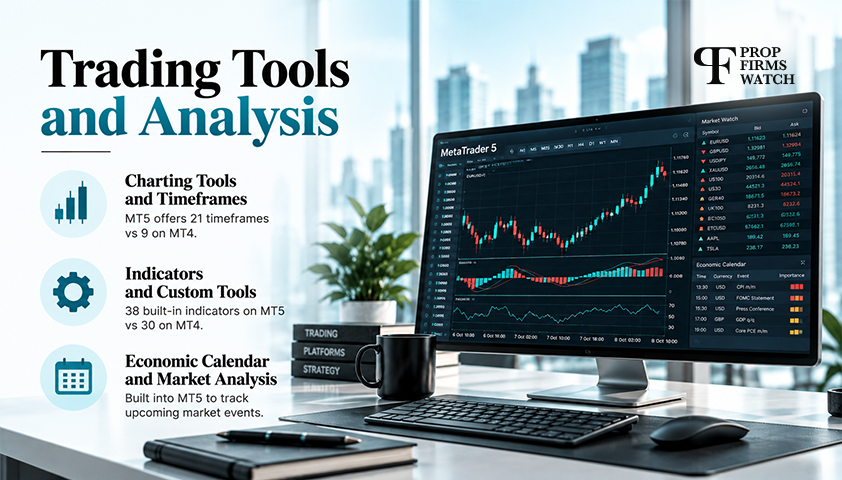
The platforms offer charting tools that allow traders to observe price movements, identify patterns, and execute trades. MT5 has 21 built-in timeframes as compared to MT4’s, which is 9. This means that traders can analyze financial instruments on shorter and longer time bases. As such, the best platform for traders depends on the timeframes they intend to use to make trades.
MT4 has 30 built-in technical indicators, whereas MT5 has 38. Both platforms provide custom indicators and tools for analyzing market conditions. They enable active traders to read price movements, momentum, volatility, and identify potential entry and exit points. However, note that many custom indicators are not compatible with the platforms, and you should always check before using them on either platform.
MT5 comes with an inbuilt economic calendar that allows one to track upcoming events and releases, including inflation rates and central bank announcements. Such data can often influence the forex market, so it is important to use a calendar to evaluate one’s exposure to volatile moves and potential risks before an important release. MT4 traders may have to rely on external platforms to access a similar tool.
MT5, on the other hand, comes with integrated features that allow traders to check news events without leaving the platform. But despite the number of useful inbuilt tools and market analysis options, MT5 does not guarantee enhanced performance. Prop traders must consider what indicators, charts, and market data to use when making financial decisions. Traders must also remember to adhere to the company’s restrictions regarding news trading.
Both MT4 and MT5 offer automated trading options. This feature allows users to perform repetitive actions, such as closing or opening positions, setting stop-loss levels, and other operations by using built-in Expert Advisors or custom-developed trading robots. While automation is helpful in many ways, it usually does not replace a trader’s skill. For example, prop account traders must still follow the specific trading regulations set by their company.
One major difference between the two platforms is that they use different programming languages. MT4 uses MQL4, while MT5 utilizes MQL5. Both languages are similar, but not identical, so MT4 indicators, scripts, and Expert Advisors do not work in MT5 without modifications. Similarly, the tools designed for MT5 cannot be used in MT4.
The MT5 platform also provides advanced strategy-testing infrastructure. Its high-efficiency tester allows for faster optimization and offers more methods for optimization, which can be critical for some automated strategies. MT4 remains relevant for those traders who value the existing ecosystem and have already designed their trading systems around it.
Before making any major decision, traders should evaluate whether it is worth optimizing their EA for the new platform and whether their existing EA is compatible with their preferred platform. They should confirm with their prop firms to ensure that their strategy is not restricted and check whether EAs are allowed or not.
Ultimately, MT5's newer technology does not automatically make an EA more profitable. Strategy quality, testing, risk management, and compliance with prop firm rules remain more important than the platform alone.
Choosing between MT4 and MT5 is more than just comparing technical features. Prop traders should also consider the firm's requirements and trading conditions before buying a challenge. Here are some of the things to consider:
Not all prop firms use the same trading platforms. Some offer MT4, others MT5, and some do not have either of these two. Make sure the desired platform is available at the firm of your choice before making any purchases. Note that some firms offering MT5 do not allow using MT4 and vice versa.
The daily losses and maximum drawdown limits are set by a firm, not a platform, so check what rules apply to the program you are buying. The drawdown limits can be set to equity, balance, or another method and can be fixed or trailing. Also, make sure how floating losses, commissions, and open positions affect your limits. This is important to know to avoid risk management issues on either MT4 or MT5 platforms.
Consider comparing spreads, commissions, slippage, order types, and execution policies. They can vary depending on the prop firm, not only on the chosen platform. It is advisable, before accepting the challenge, to study the specific execution conditions that the provider offers.
It is necessary to examine the restrictions imposed by the prop firm on the use of Expert Advisors, news trading, high-frequency strategies, copy-trading, and other methods. While the platform can allow a particular type of trade, the prop firm can prohibit it. In this case, researching the terms offered by the prop firm is required before opening any trades.
When logging in after purchasing a challenge, it is crucial to choose the correct platform, server, and account type. Wrong credentials or server may make you ineligible to log in to your account. Check that the trading tools work properly before starting to make trades.
Ultimately, MT4 vs MT5 for prop trading depends on the specific requirements and the conditions offered by firms. The most ideal solution is the one that fits your strategy and at the same time allows you to comply with the firm’s policy.
Both platforms offer useful features for traders, but each has limitations worth considering before choosing a trading environment.
Has a familiar interface. Many forex traders already know how MT4 works.
MT4 offers an established library of customizable indicators and Expert Advisors.
Existing strategies can be imported into MT4 easily. This allows traders to retain their existing tools without having to rebuild their system or re-code their strategy in a new platform.
Fewer built-in tools: MT4 provides nine timeframes and 30 built-in indicators, while MT5 has 21 timeframes and 38 indicators.
Older programming environment: MT4 uses MQL4 while MT5 utilizes a more advanced MQL5.
Limited native multi-asset functionality: MT4 was designed to be used mainly for forex trading.
More analytical options: additional timeframes and indicators help you to achieve better technical analysis.
Expanded order functionality: MT5 supports more pending order types and Depth of Market features.
Advanced strategy testing: multithreaded strategy tester provides additional testing and optimization options.
Possible incompatibility: MT4 expert advisors and custom indicators may need to be converted or redeveloped for MT5.
Learning curve: Some traders may need to spend time learning how to use MT5.
Limited availability: Some proprietary trading firms or trading programs may not offer MT5.
Ultimately, the better option depends on your trading strategy, existing tools, and preferred prop firm's requirements. More features are valuable only when they serve a practical purpose in your trading process.
When looking at MT4 vs MT5 forex trading, the choice between them depends on the tools, strategies, and opportunities each provides. They both support forex trading, technical analysis, order execution, and strategy testing. However, each has its advantages and disadvantages.
MT4 is suitable for those who want to trade currencies and are comfortable with the tools and graphical interface. It has a good set of charting tools, technical indicators, and order management capabilities. Moreover, MT4 has Expert Advisors, programs that allow you to automate trading on the MetaTrader platform. This makes it the preferred choice for those who want to test their EA or have customized indicators.
On the other hand, MT5 offers 21 built-in timeframes while MT4 provides 9. It ALSO comes with more built-in indicators and additional pending order types. These differences may be advantageous to a forex trader who wants to analyze price action, enter and manage positions more flexibly, and test more strategies for automated trading. The enhanced strategy tester in MT5 could also be an advantage if one wants to design and perfect a forex robot.
However, the availability of currency pairs is determined by a broker or prop firm, and the same goes for spreads, commissions, slippage, and other trading conditions. Therefore, when choosing between MT4 and MT5, forex traders should focus on the offered instruments and conditions within a specific brokerage environment. Otherwise, they risk missing out on better execution provided by another broker.
In short, MT4 may be more appealing to those who value the platform’s popularity and compatibility with various forex tools, whereas MT5 may attract those who want to benefit from its charting and analytical tools. In most cases, the choice between MT4 and MT5 depends on individual trading needs and the opportunities provided by particular brokers.
Before choosing between MT4 and MT5, determine which of the platforms suits your trading style and the requirements of the prop firm. This checklist will guide you on how to select a suitable platform before spending money on a challenge account;
Confirm the platform’s availability: Find out if the prop firm you are considering offers MT4, MT5, or both for your desired account program. Not all account programs offer the same tools.
Check tool compatibility: Check whether the tools you want to use, such as indicators, Expert Advisors (EAs), or scripts, are available on your preferred platform. Note that MT4 tools often need to be converted to work in MT5.
Compare the trading conditions: Check the spreads, commissions, slippage, and execution conditions. These conditions may affect the trading costs and can differ depending on the provider.
Learn the rules: Study the daily loss limits, maximum drawdown calculations, news trading restrictions, and automated trading rules before buying a challenge. Knowing the rules will allow you to pick a suitable platform.
Verify available markets: Make sure that the currency pairs or other trading instruments you want to trade are available for the type of account you choose.
Test your strategy: If you can, try out your indicators, order placement, and overall strategy in a demo version before you stake real money. This will allow you to identify what platform works best for you.
Below is a scenario-based table that can help you identify which option to consider:
Trader Profile | Platform to Consider | Reason |
Forex trader using established MT4 Expert Advisors (EAs) | MT4 | Allows continued use of existing tools without converting them for another platform. |
Trader who relies on multiple chart timeframes | MT5 | Offers 21 built-in timeframes compared to MT4's, which is only nine. |
Trader interested in multiple asset classes | MT5 | Offers broader multi-asset functionality, subject to the prop firm's available instruments. |
Algorithmic trader developing new systems | MT4 or MT5 | The choice depends on programming requirements, compatibility needs, and strategy-testing features. |
Trader who relies on multiple order execution. | MT5 | MT5 offers 6 order types compared to MT4, which has 4. |
Trader who prefers a familiar, straightforward forex trading environment | MT4 | The platform’s charting and trading tools are easy to use and understand. |
Trader who wants an integrated economic calendar and advanced strategy tester | MT5 | Combines built-in economic-event information with multithreaded strategy testing and optimization capabilities. |
The goal is not simply to select the platform with more features, but to choose one that supports your approach and meets the prop firm's requirements.
The decision of choosing between MT4 and MT5 for prop trading ultimately depends on an individual's trading style and requirements. While both platforms provide charting, order execution, and automated trading capabilities, the differences in their features can affect a trader's performance.
MT4 is a suitable option for forex traders who value the ability to use existing Expert Advisors or customized indicators and strategies. MT5, on the other hand, is a better choice for those seeking more timeframes, indicators, and testing options.
However, neither platform promises improved execution, increased profitability, or a bigger chance of passing a prop firm challenge. The spreads, commissions, execution conditions, limitations of drawdown, and trading restrictions are all determined by the prop firm and challenge type.
Before buying a challenge, double-check the platform availability, the rules established by a firm, and the tools’ compatibility. Do not only focus on the platform’s features or age in the market. Instead, take a closer look at the actual trading conditions of the prop firm.
Ultimately, there is no better trading platform. It all depends on your preference and needs. Always pick the platform that will suit your strategy and a prop firm’s requirements. Switching to a newer platform is only worth it if it accommodates your trading methods.
Both platforms have their advantages and disadvantages, so it is impossible to say which one is better. MT4 is more suitable for those who want to trade forex using Expert Advisors, and MT5 has more analytical tools and advanced multi-asset trading instruments. It depends on the strategy and the prop firm of your choice.
The main differences include programming languages, built-in timeframes, technical indicators, pending order types, and strategy-testing capabilities. MT5 offers more built-in analytical features, while MT4 remains popular among traders who prefer its established ecosystem.
Generally, no. MT4 Expert Advisors are developed using MQL4, whereas MT5 uses MQL5. Existing EAs usually require conversion or redevelopment before they can run on MT5.
Not necessarily. Execution depends on factors such as the broker or prop firm's infrastructure, spreads, liquidity arrangements, commissions, and order handling. Using MT5 does not automatically guarantee faster or better execution.
No. Some prop firms support both platforms, while others offer only one or use alternative trading software. Always verify platform availability for your specific program before purchasing a challenge.
Both platforms support automated trading through Expert Advisors. MT4 may be preferable if you already have a compatible, tested EA, while MT5 offers more advanced strategy-testing capabilities. Your firm's rules on automated trading also matter.
Both platforms can support instruments such as gold and indices, depending on the provider. Check the prop firm's available markets, symbol specifications, trading hours, and applicable restrictions before choosing an account.
Beginners should focus on the platform supported by the prop firm of their choice and the tools they need to learn their strategy. MT4 may be a great start for those who want to focus on forex, while MT5 offers more analytical tools. However, one should not forget about risk management and the rules provided by the firms.
Disclaimer: This article is for informational purposes only and should not be considered financial advice. Always review each prop firm’s official rules before making a purchase.